English
What is PAXG? PAXG vs XAUT, and is it backed by gold?How tokenized gold compares with gold ETFs and bars, and how to buy it
Both PAXG and XAUT are backed by real gold: each token stands for one fine troy ounce of a London Good Delivery bar. PAXG's gold sits in London vaults in the custody of Paxos, a trust company regulated by the US Office of the Comptroller of the Currency; XAUT's gold sits in Switzerland with a Tether company. On 6 October 2026 both traded at about $4,140 an ounce, a few dollars either side of the spot gold price.
They make sense in three situations: you already hold crypto and want part of it in gold; you want to buy a fraction of an ounce and trade at weekends; or you want gold you can move into a wallet you control. If you simply want some gold for the long run, a US gold ETF costs 0.10% to 0.40% a year and sits in an ordinary brokerage account. And if you want metal in your hand, both tokens need at least 430 of them for a bar, roughly $1.78 million at October prices.
Before buying, settle three things:
- Check you are allowed to buy. XAUT is offered only to investors outside the US. Binance.com does not take new users from the US, UK, Canada or the EU; elsewhere the country list on the first sign-up screen is the answer. In the US, PAXG is sold by Paxos and by US-licensed platforms such as Binance.US.
- Compare the token price with spot gold. A few tenths of a percent above spot is normal. More than 1% above, wait.
- Decide where it will live. On an exchange, your balance is a claim on the exchange; in your own wallet, a lost recovery phrase cannot be undone. Both are covered below.
In this article
What is PAXG, and what stands behind each token
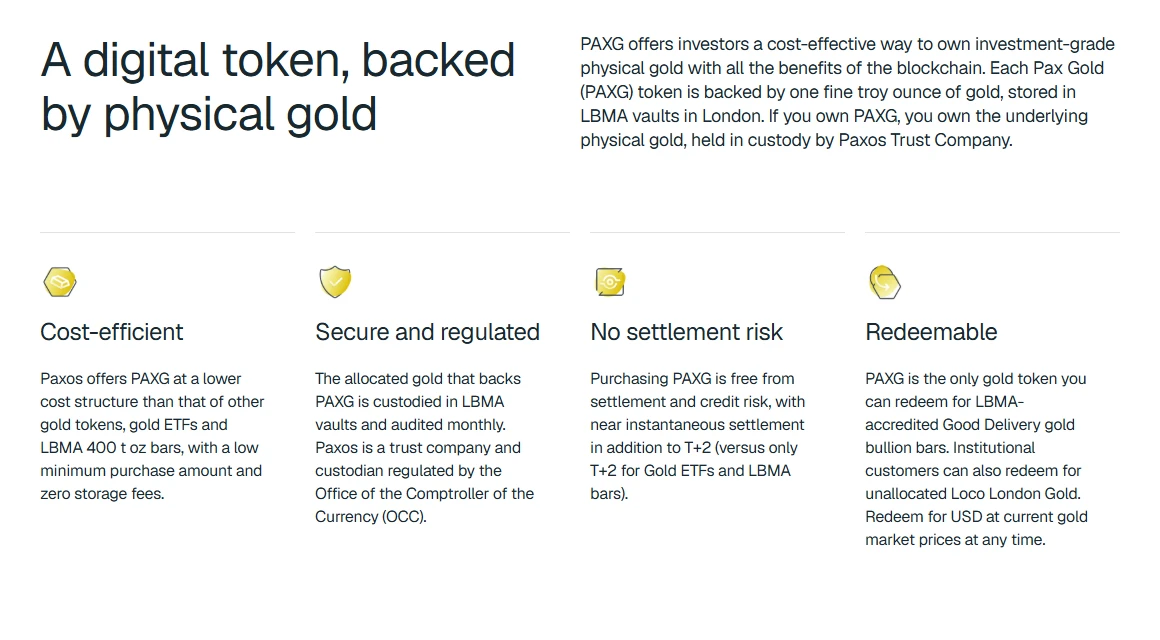
The token is a record on a blockchain. What gives it value is the bar behind it and the issuer's promise to hand over gold, or dollars at the gold price, when you bring the token back. So three questions come first: where the gold is, who holds it, and whether you can get it back.
| Compared on | PAXG | XAUT |
|---|---|---|
| One token is | 1 fine troy ounce of a London Good Delivery bar | Same |
| Issuer and custodian | Paxos Trust Company, regulated by the OCC | TG Commodities, part of the Tether group |
| Where the gold is | LBMA vaults in London (Brink's) | Vaults in Switzerland |
| Who can buy | US and non-US investors | Non-US investors only |
| Blockchains | Ethereum | Mainly Ethereum, also BNB Chain and others |
| Management or storage fee | None | None |
| Redeem for a bar | From 430 tokens, delivered only to a vault in the UK | From 430 tokens, delivered to an address in Switzerland, 0.25% fee plus shipping |
| Redeem for dollars | Yes, at the gold price | Cash settlement on request |
| Size | About $1.79 billion, 432,000 tokens | About $2.92 billion, 705,000 tokens in circulation |
Size figures from RWA.xyz on 6 October. XAUT's redemption minimum and fee come from a third-party summary; confirm them on the Tether Gold site before you apply.
The 430 figure comes from the bars themselves: a London Good Delivery bar weighs between 350 and 430 ounces and is delivered whole. With a handful of tokens, the practical route to metal is to sell them for dollars or USDT and buy small bars or coins from a dealer, paying a spread at each end.
PAXG vs gold ETFs like GLD, and bullion: where the money goes
A gold token removes the holding cost and adds exchange and network costs. Side by side with the two usual alternatives:
| Compared on | Gold token | US gold ETF | Bars and coins |
|---|---|---|---|
| Yearly cost of holding | No management or storage fee | GLDM 0.10%, IAU 0.25%, GLD 0.40% | Your own storage, or a safe deposit box |
| Each round trip | Exchange fee (0.1% on a regular Binance spot account), spread, network fee to withdraw | Commission and spread | Roughly 3% to 6% |
| Smallest purchase | A few hundredths of a token | One share | A 1 g bar |
| When you can trade | Around the clock, weekends included | Exchange hours | Dealer hours |
| Physical metal | From 430 tokens | No | Already physical |
| Main risks | Issuer, exchange, wallet keys | Fund and broker | Storage, purity, buy-back discount |
ETF fees from the fund sponsors. For bullion spreads, see how to check a gold dealer's quote.
Take $10,000 held for five years. GLDM at 0.10% a year costs about $50 over the period; GLD at 0.40%, about $200. PAXG has no holding fee; buying and selling it once on Binance costs 0.1% each way, about $20, plus the spread.
The token can also cost more than the gold. On 6 October RWA.xyz showed PAXG trading at $4,147 against a gold value of $4,141, a premium of about 0.14%, or roughly $14 on $10,000. In thin trading or a fast market that gap widens, which is why checking the two prices before you click matters more than the holding fee.
How to buy PAXG or XAUT on Binance
Binance spot lists PAXG/USDT. XAUT was added on 26 March 2026 with pairs including XAUT/USDT and XAUT/USDC, under a Seed Tag, Binance's label for newer assets that may swing more; you confirm a risk notice before your first trade.
- Make sure you can register, and hold some USDT. Opening the account and passing identity checks are covered in the Binance sign-up guide.
- Open spot trading and search PAXG/USDT or XAUT/USDT. Compare the price with spot gold first; if the gap is wide, wait.
- Use a limit order, not a market order. Set it close to the gold price. When volume is low, a market order can sweep several price levels and cost more than the fee.
- Note the fee. Binance's fee page in September 2026 showed 0.1% per trade on a regular spot account, or 0.075% paid in BNB.
- To hold it yourself, withdraw to your own wallet. PAXG runs on Ethereum, so keep a little ETH for network fees; XAUT can also go over BNB Chain. Send a small amount first, confirm it arrives, then send the rest. A wrong network or address cannot be reversed.
If you leave it on the exchange, treat it as gold exposure inside an exchange account: easy to sell, but what you own is an entry on the exchange's books, and it shares the fate of everything else in that account if the exchange runs into trouble.
What you have to accept before buying
- The price is the gold price, falls included. Gold set a record of $5,589.38 an ounce on 28 January 2026 and was about $4,141 on 6 October, some 26% lower. A token takes every bit of that fall.
- The issuer can freeze addresses. In November 2022, at the direction of US federal law enforcement, Paxos froze 11,184.38 PAXG, then worth about $19 million, at four addresses linked to FTX. Ordinary holders will not meet this, but it shows the token is not beyond anyone's control.
- The issuer is the risk you are taking. You are trusting Paxos or Tether to keep the gold in the vault and pay out if something goes wrong. PAXG's vaulted gold is audited monthly and the reports are on the Paxos site; spend five minutes on the latest one before you buy.
- Nobody can reverse a wallet mistake. Once the tokens are in your own wallet, a lost recovery phrase, the wrong network or the wrong address means they are gone.
A gold token protects against what gold protects against: a falling home currency, long inflation, a loss of confidence in the system. It is no steadier than the metal, just a different way of holding it. For how large gold's share should be, see how much is "a small slice".
Is selling taxed?
Treatment varies, and most tax authorities handle a gold token as a cryptoasset, taxing the gain or loss when you sell. In the US, IRS Notice 2023-27 says it will treat an NFT as a collectible when the asset behind it is a collectible. Following that reasoning, our reading is that a token backed by gold is likely to be taxed as a collectible, with long-term gains taxed at up to 28% rather than the 0%, 15% and 20% bands for shares. The IRS has not said anything specific about PAXG or XAUT. In the UK, HMRC treats disposals of cryptoassets as subject to capital gains tax.
Wherever you are, record the date, quantity, price and fee of each purchase and export the exchange's trade history. With those, the gain is straightforward to work out in the year you sell; if the filing itself is unclear, take the records to a local tax adviser.
When a token fits, and when an ETF or bar is better
- A gold token: you already use a crypto account and want part of it in gold, you want a fraction of an ounce, you need to sell at weekends, or you want assets in a wallet you control.
- A gold ETF: you have a brokerage account, plan to hold for years, and care about the yearly fee and the investor protections that come with a regulated fund.
- Bars and coins: you want the metal in your own hands and accept a few percent lost on the round trip plus storage. Check a dealer's quote first, as set out in the ways to buy gold.
Gold has come down from its January record. If you are thinking of buying now, the section on buying in stages in gold at record highs applies, and the staged-buy calculator shows the average cost of splitting a purchase.
FAQ
- Is PAXG backed by real gold?
- Each PAXG stands for one fine troy ounce of a London Good Delivery bar held in LBMA vaults in London by Paxos, a trust company regulated by the OCC, and the vaulted gold is audited monthly. PAXG left on an exchange is an entry on the exchange's books; PAXG in your own wallet is a token you hold on-chain.
- PAXG vs XAUT: which is better?
- Both track the gold price and charge no management fee. They differ in where the gold is (London for PAXG, Switzerland for XAUT), who can buy (XAUT is not offered to US investors), which chains they run on (PAXG on Ethereum only, XAUT also on BNB Chain and others) and size (about $2.92 billion for XAUT and $1.79 billion for PAXG on 6 October 2026). US readers can only use PAXG; outside the US, the choice usually comes down to which issuer you trust more and which network you prefer.
- Can you redeem tokenized gold for physical gold?
- Yes, but the threshold is high. Both PAXG and XAUT need at least 430 tokens, about $1.78 million at 6 October 2026 prices. Paxos delivers only to vaults in the UK; XAUT is delivered to an address in Switzerland with a 0.25% fee plus shipping. Smaller holders can sell the tokens for dollars and buy bars or coins from a dealer.
- Does PAXG charge a fee for holding it?
- There is no management or storage fee, and Paxos says on-chain transfer fees have been removed. The costs are the exchange's trading fee (0.1% on a regular Binance spot account), the spread, and the Ethereum network fee when you withdraw.
- Can US residents buy XAUT?
- No. XAUT is offered only to investors outside the US, and Binance.com does not accept US users. In the US, the gold token available is PAXG, sold by Paxos and by US-licensed platforms such as Binance.US.
Sources
- Paxos: Pax Gold (PAXG): backing, London vaults, OCC regulation, redemption, removal of on-chain transfer fees.
- Binance.US: All About PAX Gold: Brink's vaults and the 430-token minimum for bars.
- RWA.xyz: PAXG and XAUT: size, price, fees and eligible investors, 6 October 2026.
- Odaily: XAUT redemption rules (July 2025): 430-token minimum, Swiss delivery, 0.25% fee.
- Paxos: freezing PAXG related to FTX (November 2022).
- SPDR Gold MiniShares (GLDM): 0.10% expense ratio; GLD and IAU fees from 24/7 Wall St. (July 2026).
- Blockchain.News: Binance lists XAUT with a Seed Tag.
- IRS Notice 2023-27: NFTs treated as collectibles by looking at the underlying asset.
- HMRC Cryptoassets Manual: capital gains tax on disposals.
- CBS News: the highest gold price in history: $5,589.38 on 28 January 2026.