English
CD vs Treasury bills: which pays more after tax?Rates, state tax, getting out early and insurance limits, and when a CD or a T-bill ladder fits
On 16 October 2026 a 52-week Treasury bill yielded 4.44% and a 26-week bill 4.35%, while one of the best online 12-month CDs, at Ally Bank, paid 4.30% APY. At headline rates that close, the bill usually leaves you with more, because its interest is exempt from state and local income tax and CD interest generally is not. The CD comes out ahead when its rate is clearly higher than the bill's, when you live in a state with no income tax, or when you would rather keep everything at your own bank.
Which one suits you comes down to three questions:
- What is your state income tax rate? At 0%, compare the two rates directly. At 5% or more, a CD needs roughly a third of a point more just to match the bill. The table below has the numbers.
- Might you need the money before it matures? A CD charges a set penalty, often a few months' interest. A bill held at a broker can be sold any trading day at the market price; a bill held in TreasuryDirect has to be moved to a broker first.
- How much are you putting in? Above $250,000 at one bank, part of a CD is outside FDIC insurance. Treasury bills have no such limit.
In this article
CD vs Treasury bill rates right now
The national average is the trap here. The FDIC's figures for the end of August 2026 put the average 12-month CD at 1.73%, far below what a bill pays. The CDs worth comparing with a bill are the high-yield ones at online banks and credit unions, and those sit close to bill yields.
| Term | Treasury bill | Ally Bank CD | Average CD |
|---|---|---|---|
| 6 months | 4.35% | 3.85% | 1.41% |
| 12 months | 4.44% | 4.30% | 1.73% |
Bill yields are Treasury's coupon-equivalent rates for the 26- and 52-week bills; the 4-week bill paid 4.02% and the 13-week 4.18%. Ally rates are APY as of 16 October. Averages are the FDIC national rates published 21 September, based on end-of-August data.
Compare like with like. Treasury quotes bills two ways: a bank discount rate (4.24% for the 52-week bill that day) and a coupon-equivalent rate (4.44%). The discount rate is calculated on face value and understates what you earn on the money you put in, so set the coupon-equivalent figure against a CD's APY.
CD vs T-bill taxes: what you keep after state tax
Both are taxed by the IRS as interest. The difference is state tax: IRS Publication 550 says interest on Treasury bills, notes and bonds is exempt from all state and local income taxes, while CD interest is generally taxed by your state as ordinary income.
Take $10,000 for one year in the 22% federal bracket and a state with a 5% income tax. The 52-week bill at 4.44% earns about $444; after $98 of federal tax you keep about $346. The Ally CD at 4.30% earns $430; after $95 of federal tax and $22 of state tax you keep about $314. The bill leaves you roughly $32 better off despite the near-identical headline rates.
Turned around, this is the CD rate you need to match a bill:
| Your state income tax | CD rate that matches the bill |
|---|---|
| None (for example Texas or Florida) | 4.44% |
| 5% | 4.74% |
| 9.3% | 5.04% |
Calculated as bill yield × (1 − federal rate) ÷ (1 − federal rate − state rate). It ignores the deduction for state tax if you itemize, so read it as an approximation. To run your own amount, term and tax rates, use the T-bill vs CD calculator.
Timing differs too. Bill interest is reported on Form 1099-INT for the year the bill matures, so a 26-week bill bought in October puts its interest into next year's return. CD interest is taxable in the year it is credited or can be withdrawn without a substantial penalty, which for most CDs means every year as it accrues.
If you need the money early
A CD's cost of leaving is fixed in advance. At Ally, closing a 3- to 24-month CD early costs 60 days' interest, which on $10,000 at 4.30% is about $71; longer CDs cost 90 to 150 days. Other banks set their own penalties, and federal rules set only a minimum, so read the disclosure before you open one. Some CDs do not allow partial withdrawals at all.
A bill has no penalty, but its price moves. At a broker you can sell any trading day at whatever the market pays. For bills the swing is small: if rates rose half a point, a bill with six months left would lose about 0.25% of its value, roughly $25 on $10,000. If rates fall, you could sell for a little more than you paid.
The catch is TreasuryDirect. You cannot sell a bill inside it; you first transfer it to a bank or broker, and only after holding it there for 45 days, so a 4-week bill bought in TreasuryDirect has to run to maturity. If there is any chance you will need the money early, buy bills through a brokerage account instead.
Are Treasury bills safer than CDs?
For most savers both are about as safe as money gets. The difference is in the limits:
- CDs at an FDIC-insured bank are covered up to $250,000 per depositor, per bank, for each ownership category. Above that, split the money across banks or ownership categories. Credit union certificates have equivalent NCUA cover.
- Treasury bills are direct obligations of the US government with no cap. Ten million dollars in bills carries the same backing as $100.
- Brokered CDs, bought through a brokerage, keep FDIC cover up to the limit at the issuing bank, but selling one early means selling it to another buyer. If rates have risen, the SEC warns, you may have to sell at a discount and lose part of what you put in. Know which bank issued it, and check you do not already hold money there that would push you over $250,000.
How to buy each, and how a ladder works
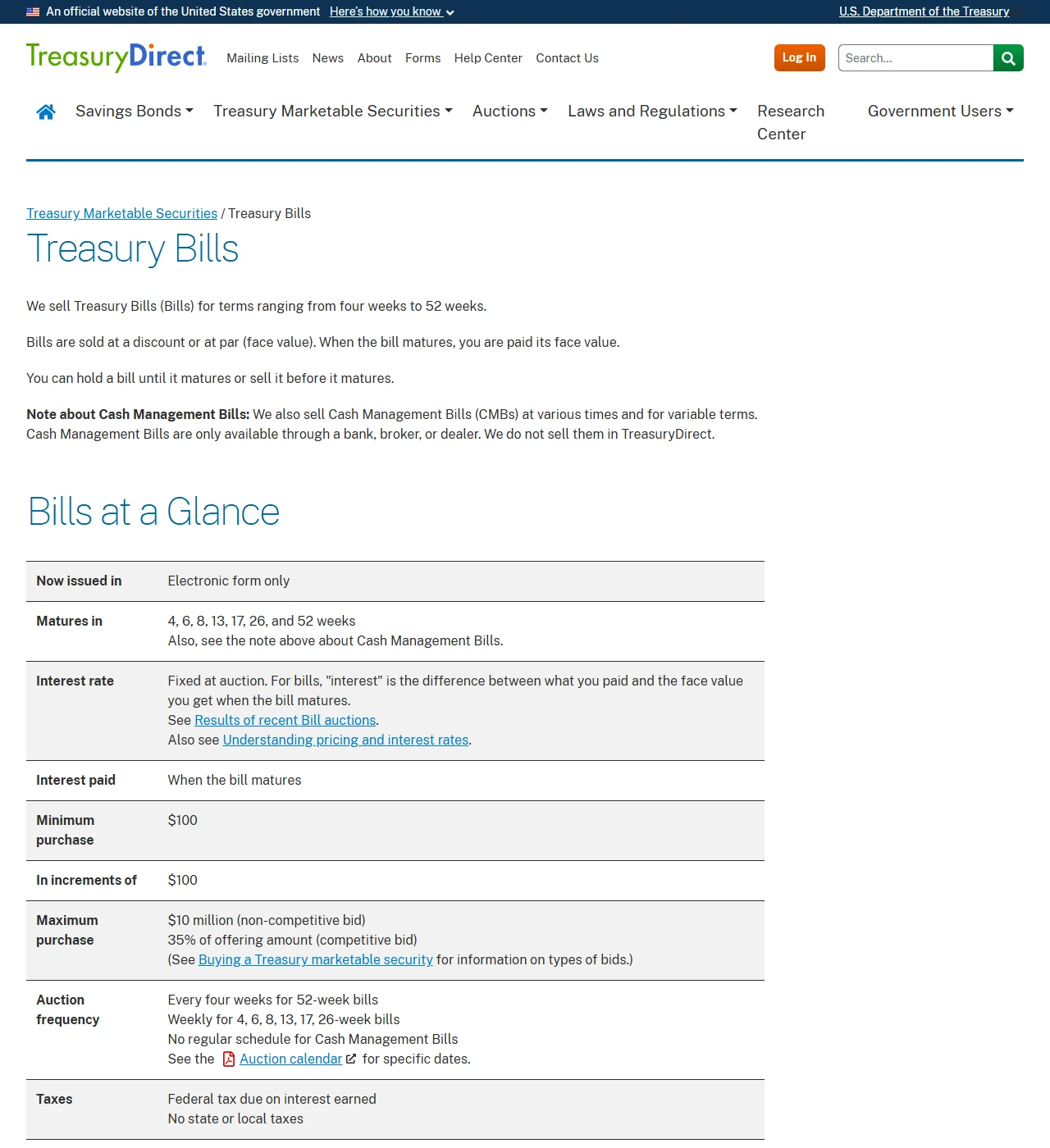
- Bills through TreasuryDirect: open an account at treasurydirect.gov, link a bank account and place a non-competitive bid before the auction. The minimum is $100 in $100 steps. You can set a bill to reinvest automatically at maturity.
- Bills through a broker: many brokerages sell new bills at auction and existing bills on the secondary market, usually without commission for new issues. This is the better route if you might sell early.
- CDs: open one at a bank or credit union, online or in a branch, and check the APY, the minimum deposit, the early-withdrawal penalty and what happens at maturity; many renew automatically into a new CD at whatever rate applies then.
A ladder spreads the money so part of it comes free regularly. With $20,000 you might buy a $5,000 52-week bill every three months for a year; from then on one matures every quarter, and you either spend it or buy a new 52-week bill. A CD ladder does the same with 3-, 6-, 9- and 12-month CDs. Bills suit this well because the auctions run weekly and each rung can be any size from $100.
Money you may need within days belongs in a savings or money market account, not a ladder; how to split it is in where to keep an emergency fund. For more on why short bills barely move in price, see short-term bonds.
Outside the US: the UK and elsewhere
The same comparison exists in most countries, with local rules on tax and protection:
- UK: fixed-rate savings bonds play the part of CDs and are protected by the FSCS up to £120,000 per person per banking licence since 1 December 2025. Short-dated gilts play the part of bills. Gains on gilts are free of capital gains tax but the coupons are taxed as income, which is why low-coupon gilts bought below face value can leave a higher-rate taxpayer more than a savings bond paying the same yield. Interest on savings counts against the Personal Savings Allowance of £1,000 for basic-rate taxpayers, £500 for higher-rate and nothing for additional-rate.
- Elsewhere: look up two things before comparing rates. First, the deposit insurance limit in your country and whether a fixed deposit falls under it. Second, whether your government sells short-term bills or savings bonds to individuals, and whether their interest is taxed differently from bank interest. Then compare what you keep after tax, not the headline rate.
Which to choose
- Treasury bills if you pay state income tax, have more than $250,000 to place, or want terms as short as a month without a penalty for changing your mind.
- A CD if its rate beats the bill even after the state-tax adjustment above, if you live in a state with no income tax and find a higher rate, or if you prefer a single fixed rate at your own bank with nothing to roll over.
- Either, in a ladder, if the money is for something one to two years away and you want part of it to come free every few months.
Whichever you pick, check what it earns after inflation: at 4.4%, with US consumer prices up 3.4% in the year to August, the real gain is about 1%. The real return calculator works it out with tax included.
FAQ
- Are Treasury bills better than CDs?
- Not always, but often after tax. On 16 October 2026 the 52-week bill yielded 4.44% and a top online 12-month CD paid 4.30% APY. Because bill interest is exempt from state and local income tax, the bill leaves more for anyone paying state tax at those rates. A CD is the better deal when its rate is clearly higher or when you pay no state income tax.
- Do you pay state tax on T-bills?
- No. Interest on Treasury bills, notes and bonds is subject to federal income tax but exempt from all state and local income taxes, according to IRS Publication 550. TreasuryDirect reports it on Form 1099-INT for the year the bill matures. CD interest, by contrast, is generally taxed by your state as well.
- Can you lose money on a T-bill or a CD?
- Held to maturity, neither loses money: the bill pays its face value and the CD returns your deposit plus interest, within the FDIC limit of $250,000 per depositor, per bank, per ownership category. Losses come from leaving early: a CD's early-withdrawal penalty, or selling a bill or brokered CD for less than you paid after rates have risen.
- What happens if I need my money before a T-bill matures?
- At a broker you can sell it any trading day at the market price, which for short bills is usually close to what you paid. In TreasuryDirect you cannot sell directly: the bill must be held 45 days and then transferred to a bank or broker to be sold, so a 4-week bill there has to be held to maturity.
- Brokered CD vs Treasury bills: what is the difference?
- A brokered CD is a bank CD bought through a brokerage. It keeps FDIC cover up to $250,000 at the issuing bank, but you can only get out early by selling it to another buyer, possibly at a loss if rates have risen, and its interest is generally taxed by your state. A Treasury bill has no insurance cap, sells easily and is free of state and local income tax.
Sources
- US Treasury: Daily Treasury Bill Rates: discount and coupon-equivalent rates, 16 October 2026.
- FDIC: National Rates and Rate Caps: average CD rates, release of 21 September 2026.
- Ally Bank: High Yield CD: APYs as of 16 October 2026 and the early-withdrawal penalty schedule.
- IRS Publication 550: Treasury interest exempt from state and local tax; reporting of CD interest and early-withdrawal penalties.
- TreasuryDirect: Treasury Bills and selling marketable securities: terms, $100 minimum, 45-day hold before transfer.
- FDIC: Understanding Deposit Insurance: $250,000 per depositor, per bank, per ownership category.
- SEC: High-Yield CDs, checking the fine print: selling a brokered CD early at a discount.
- FSCS: deposit limit, GOV.UK: Capital Gains Tax on gilts and GOV.UK: tax-free interest on savings.