English
Want to hold a little US dollars? Here are the routes ordinary people takeBank FX, cash, stablecoins, offshore accounts, and the catches
If you live somewhere the local currency has visibly weakened over the past couple of years, someone around you has probably already been muttering "switch some into dollars and just hold it". A friend who runs a small business told me he is not trying to make money off dollars. He just watches the same invoice convert back into fewer and fewer units of local money and feels uneasy, so he wants a way out. That anxiety is real, but behind the tidy phrase "switch some into dollars" sit several different routes, each with its own threshold, cost and catch. This piece lays them out one at a time.
Up front: this article does not decide for you, and it will not teach you how to get around any rules. It aims to help you see, before you act, what holding dollars actually protects against, which routes exist, what each one costs, and the two most overlooked catches: the exchange rate and your local rules. Seeing that clearly is what stops you dodging one risk only to land in another.
Dollars cover a falling home currency, not rising prices
- Holding dollars hedges your local currency depreciating against the dollar, not "global inflation". The dollar gets diluted too, just usually more slowly than a fast-falling local currency.
- There are roughly five routes: bank FX deposit, physical foreign cash, USD-pegged stablecoins, an offshore broker or account, and USD-denominated funds. Their thresholds and risks span a wide range.
- What actually trips people up is usually not which route they pick, but two ignored things: the exchange buy-sell spread and your local FX rules.
- A stablecoin is a "USD-pegged crypto asset", not the dollar itself, and adds issuer and depeg risk. Underground money changers and "guaranteed appreciation" deals are to be avoided entirely.
On this page
- First, get clear on what holding dollars protects
- Route 1: a bank foreign-currency deposit
- Route 2: physical foreign cash
- Route 3: USD-pegged stablecoins
- Route 4: an offshore broker or account
- Route 5: USD-denominated assets or funds
- Five routes side by side in one table
- Exchange rate, controls and legality: the overlooked catch
- Look up the rate and the spread yourself
- If your country caps how much foreign currency you can buy
- Currency offers to walk away from
- FAQ
First, get clear on what holding dollars protects
Many people treat "holding dollars" as a catch-all store of value. In fact what it protects against is quite specific: when your local currency weakens against the dollar, the local-currency value of the dollars you hold rises accordingly, offsetting part of the loss. It deals with one risk, local-currency depreciation.
But it is not a cure-all. The dollar has its own inflation. Leave dollar cash or a current account sitting and its purchasing power still slowly shrinks, only more slowly than against a fast-falling local currency. So the more accurate way to put it is: holding dollars means "standing in a relatively steadier currency", not "never fearing rising prices again". I cover that distinction in more detail in why cash loses value; if you want to see side by side what the dollar, gold and bonds each protect, that table is in the safe-haven assets comparison.
The five routes below are different forms of that one hedge, not different protection goals.
Route 1: a bank foreign-currency deposit
The most common route, and the most direct for most people, is to open a foreign-currency account at a local bank and convert local money into dollars to deposit. The upside is that it sits inside the regulated financial system, leaves an account record and is relatively low-effort, and in many places you can even put it in a term deposit that pays a little interest.
Its cost lies mainly in two places. One is the exchange spread: there is a gap between the bank's buy and sell rates, so converting in and back out again eats a slice each way, which I cover separately below. The other is regional variation: whether you can open a foreign-currency account, how much you can hold, and how cash withdrawals and cross-border movement are treated all differ by place and may change at any time, so ask your own bank rather than going on what worked for someone else. The threshold is usually low, which suits ordinary people who want a steady start, but do not overlook that invisible spread cost.
Route 2: physical foreign cash
Some people prefer to convert dollars into actual banknotes they can hold, for the reassurance of something "visible and in hand". The upside of cash is that it is direct and does not depend on any account system; but its cost is not small and is often underestimated.
First, the exchange spread on cash is usually wider than on electronic foreign currency, so each round trip loses more. Second, banknotes have to be stored by you, and loss, damage or theft is all on you; once the amount is large, the storage itself becomes a burden and a risk. On top of that, like a bank deposit it does nothing about the dollar's own inflation, and it earns no interest. For most people, keeping a small amount of cash for emergencies is understandable, but hoarding a larger sum as cash over the long term is poor value.
Route 3: USD-pegged stablecoins
A route mentioned a lot in recent years is the USD-pegged stablecoin. First, get clear on what it actually is: a stablecoin is a USD-pegged crypto asset, kept at "roughly one coin equals one dollar" by some issuer. It is not a US dollar, and it is not a bank deposit. It runs on a blockchain, with fast transfers that move easily across borders, which is why some people are drawn to it.
But its risks are just as real, and of a different type from the first two. One is issuer risk: the peg is held by the issuer's reserves and credit, and whether those reserves are sufficient and transparent decides how trustworthy the coin is. Two is depeg risk: history has seen stablecoin prices drift noticeably away from one dollar for short stretches, so "stable" is not set in stone. Three is operational threshold and platform risk: you usually have to buy, hold and convert it on a crypto exchange, which drags in the exchange's own security and compliance, plus the question of whether it is legal where you live.
This page puts no real exchange link of any kind and does not teach you the steps. If you genuinely want to understand what to check before acting on an exchange, such as whether the platform is legitimate, how fees are calculated, whether risk disclosures exist and whether it is allowed where you are, see the pre-buy checklist we put together for exactly that. Work through that page first, then decide whether to go anywhere near it.
Route 4: an offshore broker or account
A step higher in threshold is holding dollars and dollar assets through an offshore broker or an offshore bank account. This route reaches more tools and offers more flexibility, but in turn it raises the bar on you noticeably.
Its cost concentrates in three points. One is the account-opening and compliance threshold: opening abroad often demands a string of proofs on identity, tax status and source of funds, with a more complex process than at home. Two is legality and reporting: where you live there are usually rules and reporting requirements for residents holding offshore accounts and moving money across borders, so check what applies to you rather than assuming. Three is distance risk: with the account abroad, disputes, platform problems or policy changes are harder to handle. This route suits people who already have cross-border needs and are willing to spend time understanding the rules; for an ordinary person who simply wants to "park some dollars", it is often too heavy a tool.
Route 5: USD-denominated assets or funds
The last route, strictly speaking, has already slid from "holding dollar cash" toward "holding USD-denominated assets". Think of certain USD-denominated money-market funds, bond funds or other products: they carry the dollar's currency property and also stack on the ups and downs of the underlying assets themselves.
What marks this route out is that it is no longer simply "standing in another currency". It bears two layers of swing at once: exchange-rate risk and the market risk of the assets invested in. The upside is the chance to earn income rather than being purely diluted by inflation; the cost is that it no longer counts as "parked steadily", and whether you can buy it, how to buy it and how tax is treated again vary by place. If this is the type you are weighing, first separate "protecting" from "growing": is this money meant to keep the principal safe, or to grow it? Different goals lead to entirely different choices, something I cover specifically in why cash loses value.
Five routes side by side in one table
| Route | Threshold | Main cost | Main risk | Liquidity |
|---|---|---|---|---|
| Bank FX deposit | Low | Exchange buy-sell spread | Regional rules, spread, the dollar's own inflation | Good |
| Physical foreign cash | Low | Wider cash spread | Storage, loss or theft, no interest | Medium |
| USD-pegged stablecoin | Medium | Trading and withdrawal fees | Issuer, depeg, exchange and legality | Good |
| Offshore broker / account | High | Opening, remittance, upkeep cost | Compliance reporting, cross-border and distance risk | Medium |
| USD assets / funds | Medium-high | Subscription and management fees | Exchange rate stacked with market swings | Varies by product |
What this table gives you is a sense of magnitude, not a ranking. Whether you can open the account, how much you may hold and what has to be declared vary a great deal by country and do change, so the local rule in force is what counts in the end.
Exchange rate, controls and legality: the overlooked catch
Beyond which route you pick, what really decides whether you come out behind is usually the three things below. They cut across routes; almost every path runs into them.
Exchange-rate risk. Holding dollars is essentially a bet that "the local currency will weaken against the dollar". But exchange rates run both ways. The local currency can strengthen back instead, and then your dollars convert into less local money than before. So the dollar is not a sure-win insurance; it just swaps one risk for another. Do not bet on direction with money beyond what you can afford to lose.
Exchange spread. Every time you convert local money into dollars and back, you pass through the buy-sell spread, an invisible toll. The spread looks like a few decimal places, but with frequent round trips or large amounts it adds up to a meaningful sum. This is also why "short-term currency trading" is usually a bad deal for ordinary people: the spread alone is enough to grind away whatever swing gain you might capture.
FX controls and legality. Rules on individuals exchanging, holding and moving foreign currency across borders vary enormously by place, some loose, some strict, and they shift with policy. Whichever route you use, find out the rules currently in force where you live, and consult a licensed, legitimate institution when needed; the section on caps further down uses India and China as worked examples. This page invents no tax rate or regulation, cites an official source for every rule it quotes, and it will never teach you how to get around rules. That is neither what HoldValue does nor any benefit to you, only risk. Doing it in compliance is what lets you sleep at night.
Look up the rate and the spread yourself
Whether holding dollars is worth it for you comes down to two numbers: how far your currency has moved against the dollar, and how much the bank keeps on a round trip. Both are easy to look up:
- Check the historical rate of your local currency against the dollar. Find a public source and look at how your currency has moved against the dollar over the past three to five years. You will get a direct feel for whether it is weakening one-sidedly or swinging back and forth, which decides how much holding dollars actually means for you.
- Check the bank's FX buy and sell rates. Go to your usual bank's rate page, put the "buy" and "sell" prices for the same currency side by side, and work out the spread as a percentage. Keep that number in mind. Next time someone tells you "there is hardly any cost to exchanging currency", you will know that is not so.
The World Bank, the IMF and similar public databases hold long-run rates and macro data (see the sources at the end).
If your country caps how much foreign currency you can buy
People reach this page with a very specific question: what is the best way to hold US dollars if my country restricts currency? The honest answer starts one step before the five routes above. Controls usually bite at one or two of three points: converting local money into dollars, keeping dollars in an account or as cash, and moving them abroad. Ask about each one separately, because the best route for you is whichever stays open at all three.
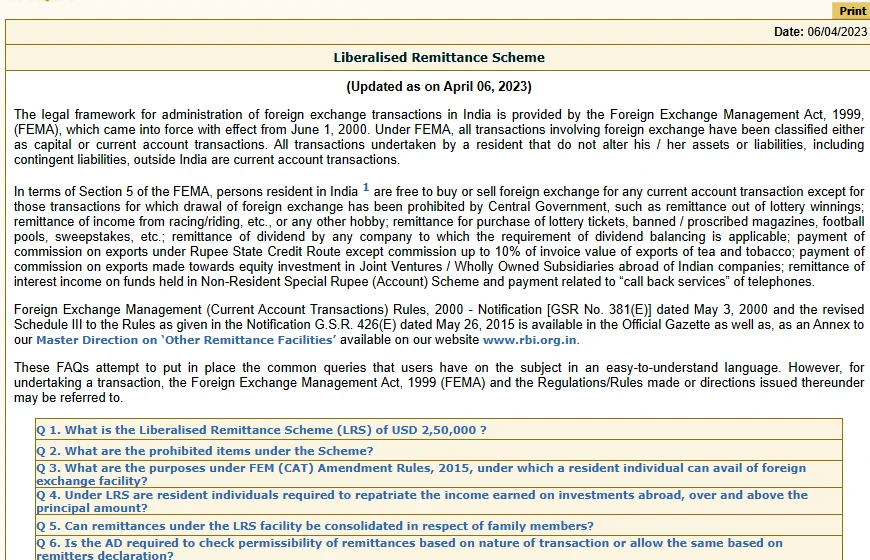
It helps to see what a cap looks like in practice. India's central bank runs the Liberalised Remittance Scheme: resident individuals, minors included, can remit up to USD 250,000 per financial year, April to March, for permissible current or capital account transactions. Its FAQ adds that a PAN is mandatory for every transaction under the scheme, that remittances for trading foreign exchange abroad are prohibited, and, in one line that surprises people, that banks cannot open foreign currency accounts in India for residents under the scheme.
China sets its cap on the conversion itself. Each person has an annual convenience quota worth USD 50,000 for buying foreign currency at a bank with their own ID, and purchases for genuine current account needs, tuition being the regulator's own example, can be made outside the quota with supporting documents. The regulator is blunt about the obvious workaround: people who borrow someone else's quota to get round the limit go on a watch list for that year and the two after, and during that time every conversion needs transaction documents. Both points come from the regulator's own Q&A pages, which are in Chinese.
Two numbers are worth putting side by side before anything else: the official rate at your bank and the rate people offer you informally. If the bank gives 100 local units per dollar and the street offers 140, that 40% gap is not a better deal. It is the price of risks you would be taking on: the deal may be illegal where you live, the other side can walk off with your money, and if an account is frozen over where the funds came from, there is nobody to complain to.
If you only have time for one conversation, have it with your bank. Ask how much you can convert in a year, whether you can keep the foreign currency in an account in your own name, and what paperwork a transfer abroad needs. Those three answers tell you which of the five routes above are actually open to you.
Currency offers to walk away from
Any one of these, and the exchange is off
- Someone pitches a private exchange channel or underground money changer with "a better rate, less hassle". Exchanging outside legitimate institutions puts both the risk and the legality entirely on you. Walk away.
- Anyone says a way of holding dollars "pays a fixed return" or "only goes up". The dollar can fall back against your currency too; that is the exchange-rate risk described above.
- They rush you with "convert now before the local currency drops hard" or "limited spots". The exchange rate will still be there tomorrow; the only person in a hurry is the one who wants the deal.
- You are asked to use emergency money, borrow, or take on leverage to exchange currency. That is no longer protecting yourself; it is betting on direction.
- You cannot explain a stablecoin's or platform's issuer, reserves and compliance. Work through the pre-buy checklist first.
FAQ
- If I hold US dollars, am I safe from inflation?
- Keep two things apart. Holding US dollars hedges "your local currency weakening against the dollar", not "global prices rising". The dollar has its own inflation too, so cash left sitting still loses value, just usually more slowly than a local currency that is falling fast. It hedges local-currency depreciation; it does not beat inflation for you.
- Is a USD-pegged stablecoin a more convenient way to hold dollars?
- A stablecoin is a "USD-pegged crypto asset" kept at its peg by an issuer. It is not a US dollar and not a bank deposit. It carries issuer-credit, reserve-transparency and depeg (price drifting away from 1 dollar) risk, and is usually handled on an exchange. It has a convenient side, but it adds a layer of platform and issuer risk, so it cannot simply be treated as holding dollars.
- My region has rules on exchanging currency. Can this page teach me how to get around them?
- No, and this page will not do that. Rules on individuals holding and exchanging foreign currency vary a lot by place and change over time. This page only flags risk and legality. For how to act in compliance, follow your local official rules currently in force, consult a licensed institution if needed, and never exchange currency through underground channels.
- Can family members pool their allowances?
- It depends on the country. India's LRS FAQ allows remittances to be consolidated for family members as long as each of them meets the scheme's conditions, but not for capital account transactions such as opening a bank account or investing, unless they are co-owners of that account or investment. China's regulator treats borrowing someone else's quota as getting round the limit and puts the borrower on a watch list for that year and the two after. Read the rule where you live rather than assuming either.
Sources
- International Monetary Fund (IMF): exchange-rate, FX and macro data by economy.
- Federal Reserve: public material on the dollar, money and interest rates.
- World Bank: long-run public data on exchange rates, inflation and more by country.