English
Your currency keeps falling. How does an ordinary household protect its savings?Steady purchasing power first, then think about growth
I grew up in a place where the local currency lost value year after year. What stayed with me is not any economic headline, but small scenes: a grandparent spending half of a freshly paid wage the same day, because "next week it won't buy as much"; the price tag on the same bag of rice being replaced every few months. You did not overspend, the wage arrives on time, yet the money in your hand gets lighter by the day. This piece is for households in a similar place. It is not about getting rich, but about one thing: how to protect the little you have already saved.
Let me be plain up front: in high inflation there is no perfect answer, and anyone who promises a way to "stay steady and double your money" is someone to be wary of. What I can offer is an order I worked out over the years, partly by making mistakes: secure basic living and emergencies first, then diversify with money you can afford to lose, and never stake the family's whole lifeline on one thing.
Get the order right before choosing any tool
- In a high-inflation environment, cash and local-currency deposits are hit hardest, and local-currency assets tend to shrink together. Diversifying must step outside the single basket of your own currency.
- Order matters more than tools: keep enough for basic living and emergencies first, then think about protection, and only last a tiny slice of higher-risk experiment.
- Foreign currency, gold and the like avoid being dragged solely by your currency, but each has a cost in exchange rate, storage, availability and legality. None lets you win without losing.
- Currency controls, product availability and the legality of holding differ a lot by place and do change. Check what is allowed where you live, and use proper channels.
On this page
- Wages chasing prices: the real feel of high inflation
- Why cash is hit hardest in high inflation
- An order: steady first, then diversify
- Ways to protect savings, and what each guards against
- Local considerations: foreign currency, availability and legality
- See what your own currency has done since
- Turning that into a plan you can run: week one, month one, after that
- What panic makes people do, and what to hold off on
- The most common mistakes
- FAQ
Wages chasing prices: the real feel of high inflation
People in low-inflation places talk about inflation as a percentage in the news. People in high-inflation places do not need the news, because it is written into daily life: on payday you rush to buy what you need to stock, because the money is worth less in a few days; price tags update so often you can no longer recall the old ones; the number in the passbook rises while the goods it buys shrink; relatives pick up the habit of "turn any spare cash into something else." Behind all of this is the same thing: wages and deposit rates fail, over the long run, to keep up with rising prices.
The figure does not fall, yet purchasing power shrinks. For an ordinary household this erosion is not an abstract indicator. It is the children's school fees, the medical reserve, the small cushion for the new year, all quietly thinning out. Admitting the anxiety is real is the first step to good decisions; but the more anxious you are, the more you should move by order, not grab at the nearest lifeline in a rush.
Why cash is hit hardest in high inflation
Ordinary inflation and high inflation harm you by the same logic, but the intensity differs completely. Where prices rise two or three percent a year, cash erosion is a slow boil that takes years to notice. Where it runs double digits or more, it falls visibly before your eyes. Two things deserve special clarity here:
- Cash and local-currency current accounts are hit hardest. They earn almost no interest, yet inflation dilutes them in full, like holding an "invisible negative interest rate." The further the rate falls behind inflation, the more negative it gets.
- Local-currency assets tend to shrink in the same direction. Local-currency deposits, products and many things priced in the local currency are all tied to the same money behind them, so when the currency weakens they often move down together in real purchasing power. You think you bought several things and spread your risk, but you are exposed to the same single variable. This is the most common "false diversification" in high inflation.
So protecting savings here has a key turn: real diversification is not buying a few more local-currency assets, but holding some value not dragged solely by the single variable of your own currency. That is why foreign currency and gold come up later: not because they are sure to rise, but because their fate is not fully tied to your household's money. To get clear first on how "protecting" and "growing" differ, revisit why cash quietly loses value.
An order: steady first, then diversify
In high inflation, the mistake people make most is not picking the wrong asset, but getting the order wrong: panic strikes, you swap all your savings into one thing, and basic living is left without a buffer. Follow the sequence below, steadying one step before moving to the next:
- Secure basic living and emergencies first. Work out a few months of necessary household spending, and keep that money in the steadiest, always-accessible form. This money is eroding too, but its first job is "available anytime," not "beat inflation." You do not gamble with the foundation.
- Then diversify, with money you can afford to lose, into tools not dragged solely by your currency. Once the foundation is steady, only the portion you will not need soon and whose loss would not hurt your life should go, in part, into foreign currency, gold and similar tools. The point is to diversify and stagger: different tools, different points in time, slowly. Do not bet it all at once, or concentrate in the one you understand least.
- Only last, a tiny slice of higher-risk experiment. If you understand it and are willing to bear it, you can put a tiny portion (small enough that a total loss would not sting) into something with extreme volatility, such as bitcoin. Halving in a short stretch is nothing unusual for it, so it can only be a fringe item, never the main protection.
The proportion is different for every household, with no number that fits everyone. How to think it through is written separately in how much is "a small slice".
Ways to protect savings, and what each guards against
Putting the common approaches side by side makes it easier to see what each guards against and where its cost lies. The table below is a relative comparison for beginners, not a rating, and does not target any specific market or moment.
| Approach | Mainly protects against | Main risk / cost | Suits |
|---|---|---|---|
| Keep enough local-currency emergency money | Sudden expenses, short-term needs | Diluted by inflation, but bought for liquidity and safety | Every household, first priority, no exposure to swings |
| Hold some foreign currency (e.g. US dollars) | Local-currency depreciation | Exchange-rate swings, local controls, storage and channel legality | When the currency falls fast and holding is legal and available |
| Allocate a little gold | Long-run inflation, systemic panic | May not rise for years, can fall short term; physical needs storage | A small slice for those who can hold long and accept swings |
| Go all-in on one thing with all your savings | (seems decisive in one move) | Extreme risk: buying at a high, forced to sell low | Not advised, a panic decision |
| Borrow / use leverage to fight inflation | (claimed to amplify protection) | Turns protection into a bet, loss and debt stack up | Not advised, beyond protecting savings |
The judgements in the table change by time and place, so read them together with the local considerations. To compare the volatility and liquidity of safe-haven tools side by side, see the safe-haven assets comparison; for how to hold foreign currency, see how ordinary people hold a little US dollars.
Local considerations: foreign currency, availability and legality
High-inflation places often come with various forms of money management, and those rules differ enormously by place and can change at any time. This site does not draw conclusions for any region. What follows is a list of what to go and check; the answers depend on the rules where you live.
- Foreign-currency exchange and holding. Whether an individual may exchange, how much, may hold, or may move money across borders, all vary by place. Use proper, legal channels and rely on official notices. This site will not, and should not, teach you to get around any management rule.
- Product availability. The same tool may not be available where you live, or may exist in a different form. Do not copy what is done elsewhere; first confirm there is a legal, proper route locally.
- Legality and proper channels. The more the money loses value, the more underground exchange and dubious "high-yield protection" offers appear, often with fraud and legal risk. Anything you cannot understand, of unclear origin, or that needs an improper route, leave it alone.
- Tax and reporting. Whether holding, exchanging or moving across borders involves reporting or tax varies by region. Check the rules where you live, and consult a qualified professional if needed. This site does not give tax or legal advice.
The general direction travels; every specific "can I, and how" question has to be answered by the rules where you live.
See what your own currency has done since
The felt sense can be magnified or numbed by emotion. Two things you can do by hand:
- Look up your currency against the US dollar over recent years. Find the historical rate of your currency versus the dollar and look at the curve over the past few years. If it slides all the way down, you can see directly that the same amount of local currency buys less foreign currency over time.
- Look up your local inflation over recent years. Go to public databases such as the World Bank and IMF (see the sources below) and check the inflation rate where you live for recent years. Divide 72 by it for a rough count of the years until purchasing power halves: about six at 12%, about three at 24%.
Swap the abstract "money is getting lighter" for a curve and numbers you have seen yourself, you will know how urgent protection should be, instead of being led by anyone's sales talk.
Turning that into a plan you can run: week one, month one, after that
Everything above is about judgement. This part is about what you do on which day. It is laid out as a timeline because the commonest failure under high inflation is not picking the wrong tool. It is trying to do the whole thing in a single afternoon.
Week one: fence off the money you are not allowed to touch
Nothing this week is about what to buy. Work out what has to be paid over the next three to six months, rent, school fees, loan repayments, the standing medical cost your household carries, and put that sum somewhere you can reach immediately and where the amount does not move with a price. Inflation will still take a bite out of it. That bite is the premium you pay for never being forced to sell at the worst possible moment, and it is worth paying. People who skip this step are the ones selling three months later at exactly the wrong time.
Done when: you can state the amount, it sits in its own account or its own line rather than mixed in with day to day spending, and you could have it in your hand within a few minutes.
Month one: learn the rules before a second sum moves
Places with high inflation usually also have currency controls, annual limits or reporting requirements, and those move faster than the coverage of them. Before anything else is transferred, establish three things through an official local channel: how much an individual may legally convert in a year, through which channels, and what paperwork is needed. If you cannot find it or cannot follow it, do not move yet. Holding cash one more month costs far less than putting savings into an arrangement whose legality you cannot explain. What this month is really for is proving the pipe works, by sending an amount small enough to lose through the entire route.
Done when: you can explain the limit, the channel and the paperwork in your own words, and one small sum has been through the whole route, tested in both directions.
After that: split the purchases, do not pick the moment
Only now does what to buy come up, and how you buy it matters more than what. Divide the sum you intend to commit into several parts and put them in on fixed dates rather than waiting for a price that feels right. The case for this is not that averaging in earns more. It is that it deletes the timing decision, which means being wrong once cannot cost you the whole plan. Write one line each time: the date, the amount, and the price or rate that day. Three months of that sheet will teach you more about your own behaviour than any chart will.
Done when: the sheet exists with dates and amounts on it, you have followed it at least twice, and you did not rewrite it in between because a price moved.
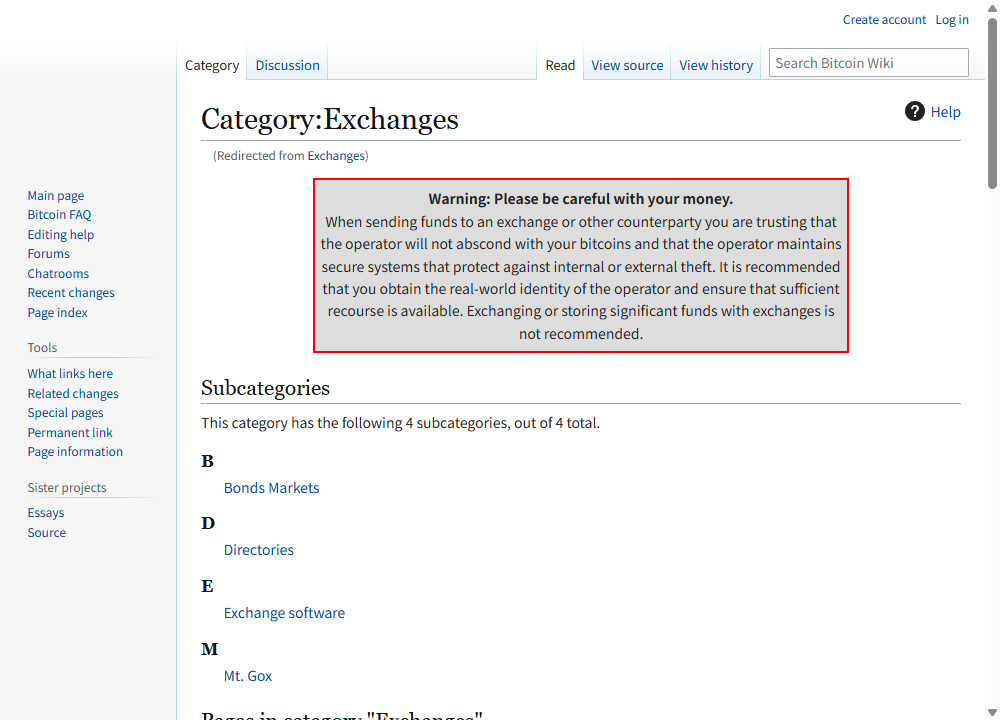
One last thing, unrelated to which asset you pick. Wherever the money ends up, do not leave it sitting long term somewhere that is merely convenient for trading. The warning below sits at the top of the Bitcoin Wiki exchanges category and makes the point independently: sending funds to an exchange means trusting the operator both to stay honest and to keep the systems secure.
Finishing the plan is not the same as getting it right. Come back in three months and check three things: whether the fenced-off money is still where you left it, whether the rules have changed, and whether your schedule survived contact with a moving price. If any one of them has slipped, repair that before adding anything new.
What panic makes people do, and what to hold off on
Four situations to sleep on first
- You are in a panic and think "I must convert all my savings today." That emotion-driven, all-at-once move is the most common way people lose money in high inflation.
- Someone urges you to borrow or use leverage to "fight inflation." That is not protection, it is a bet, and principal and debt press down together.
- Someone offers underground exchange, an improper channel, or a dubious "high-yield protection." These often hide fraud and legal risk, and money that leaves that way rarely comes back.
- Any pitch carrying words like "guaranteed protection / locked-in returns / can't lose." When the currency itself cannot be held steady, no institution can lock in a return for you, and a guarantee printed on a flyer will not be honoured.
In high inflation, going slower, using proper channels, and moving only money you can afford to lose almost never leaves regret. What truly hurts a household is usually that one panicked move to "shift everything out right now."
The most common mistakes
I have seen these traps, and shielded my own family from them. What they share is turning "protection" into "speculation" or a "bet."
- Panic all-in on one thing. Swapping all your savings into dollars or gold at once looks decisive, but it stakes everything on a single price and a single moment. Buying at a high, or being forced to sell low when you need cash, can cost you more than inflation would.
- Borrowing to fight inflation. Using borrowed money to buy protective assets adds leverage onto an already fragile household. When the asset swings, the debt does not shrink with it, and the squeeze from both sides hurts most.
- Believing "guaranteed protection" scams. The less stable the currency, the more pitches like "sure profit, protected value" and "locked-in returns" appear. Remember one line: every asset carries risk, no one can guarantee no loss, and the fuller the promise, the more likely it is a trap.
- Mistaking speculation for protection. Seeing something surge short term and piling in heavily is, in name, protecting value, but in reality chasing a rise. The goal of protecting savings is to keep your principal from being eaten first, not to gamble along with the market.
FAQ
- My currency keeps falling. Should I rush to convert all my savings into dollars or gold?
- Converting everything at once is not advised. Panic-buying all-in on any single asset is a new risk in itself: you may buy at a high, be forced to sell low when you need cash, or run into channel problems. A steadier order is to keep enough local currency to cover daily life and emergencies first, then use only the money you can afford to lose to diversify, in stages, slowly.
- Is holding foreign currency or gold legal where I live?
- Rules on personal holding of foreign currency and gold, and on exchange and cross-border movement, differ a lot by place and do change. This site does not draw conclusions for any region. Follow your local official rules currently in force, use proper and legal channels, and never use underground routes.
- To beat inflation, is it worth borrowing money to buy protective assets?
- It is not worth it, and the risk is high. Borrowing means leverage. If the asset falls in the short term or the local currency swings, you may owe principal and interest while facing a loss, turning protection into a bet. Money meant to protect savings should be your own, and money you will not need soon.
Sources
Historical inflation and exchange-rate data are in the two public databases below; the two define their series slightly differently:
- International Monetary Fund (IMF): inflation, exchange-rate and macro data by economy.
- World Bank: long-run public data on inflation and prices by country.