English
Why short-term bonds count as 'steady', and how ordinary people take partWhere the low volatility and the income come from, and the rate risk
The first time many people hear "government bonds", the reaction is "that's the state borrowing money, what has it got to do with me?" But the moment you start thinking "I have some cash I don't need for a while, and I'm not happy watching it sit in a current account being eaten by inflation", short-term bonds almost always come up, tagged in article after article as "the steadiest kind". The question is, what exactly makes them steady? And how steady is that "steady", really? This piece works through it in order: explain the mechanism first, then how to take part.
Let me put the main thing up front: short-term bonds are a tool for "staying steady and keeping liquidity", not for "earning". If you go to them hoping to make a bit more, you will probably be disappointed, and you may even reach for things you shouldn't touch in the hope of squeezing out more. By the end of this you should be able to tell what they can do for you, what they cannot, and roughly how you might take part where you live.
What makes it steady is the short maturity, not the yield
- Short-term bonds have low volatility because the term is short and they are repaid at maturity, which makes them less sensitive to rate moves.
- Their return comes from interest. Their job is "steady plus liquidity", not high returns, so don't count on them to make you money.
- Ordinary people have roughly three routes: buying directly through an official channel, money-market funds, and short-bond ETFs. The entry bar and cost differ.
- They still carry rate risk and reinvestment risk, and against high inflation they may not beat prices. They are not free of risk.
On this page
- What a short-term bond actually is
- Where the "steady" comes from: the upside of a short term
- Where the yield comes from: interest, not price rises
- Their job is "steady", not "earning"
- How these differ from a bank deposit, and what they are actually called
- How ordinary people can take part: three routes
- The three routes side by side
- Today's yield, set beside today's inflation
- Short-dated, short maturity, short duration: what the labels tell you
- The limits: rate risk, reinvestment risk, and not beating inflation
- FAQ
What a short-term bond actually is
Take it apart and it is plain enough. A government bond is the "IOU" a government issues when it borrows from the public, with a promise to pay you back the principal plus interest at maturity. "Short-term" simply means the borrowing period is short, usually within a year or within two to three years (where the line falls, and what each type is called, differs from country to country). You lend money to a highly creditworthy issuer, agree on a not-too-long term, and get your principal plus interest back at the end. That is the whole core of a short-term bond.
Precisely because the issuer is the government, and the chance of default in mainstream economies is usually very low, they are often treated as the tier that is "closest to cash, but pays a little more than cash". But note: "low chance of default" is not the same as "no risk at all". That difference is exactly what the later part of this piece is about.
Where the "steady" comes from: the upside of a short term
There is an intuitive reason short-term bonds have low volatility: the nearer the maturity date, the closer the price sits to the principal it will finally repay you.
A bond can be bought and sold in the market before it matures, and its price moves up and down with rates. There is one key rule here: when market rates rise, older bonds that were issued at lower interest become less attractive, so their price falls; when rates fall, the reverse happens. But how big that effect is depends directly on how long there is left until maturity. A bond with twenty years to run can swing hard in price when rates move; a bond maturing in a few months, about to repay its face value, has almost no room to swing.
So the "steady" of a short-term bond is not something anyone guarantees. It is the natural result of a short term making it insensitive to rate moves. The closer it gets to maturity, the more it behaves like a fixed amount about to be paid out. This is also why a long-term government bond is not "steady" at all, and can in fact be quite bumpy.
Where the yield comes from: interest, not price rises
Many people judge an asset by "will it go up after I buy it", but short-term bonds should not be seen that way. Their return comes mainly from interest, the reward the issuer pays for borrowing your money, with the principal returned and the interest settled at maturity. What you earn is "the bit of interest from lending to the government", not a doubling of price.
This matters, because it sets how high your expectations should be. The level of interest follows the overall rate environment: when rates are high, newly issued short-term bonds yield more; when rates are low, they yield less. What they give you is a relatively certain but limited return. Put another way, their appeal was never "how much can it pay", but "while still getting my principal back, can it pay a little more than a current account".
Their job is "steady", not "earning"
Short-term bonds are where you put money you "want to keep steady but don't want lying completely idle", not a tool for chasing returns.
The role they play in a savings setup is closer to "a buffer between emergency money and long-term investment": a little more interest than a current account, while keeping decent liquidity and low volatility. What they want is to be steady and available at any time, not high returns. The moment you start finding the "yield too low" and try to squeeze more out of this money, you tend to get led toward longer-duration bonds or riskier debt, which has already left the original point of "steady". For how big a share of the whole this money should be, HoldValue has a separate piece on how much is "a small slice".
How these differ from a bank deposit, and what they are actually called
Two things trip people up here. The first is naming: the short-dated end of government debt is usually called Treasury bills, often shortened to T-bills, while longer issues are called notes or bonds, and a broker listing them under government securities means the same family. The second is that people file them mentally next to a term deposit, because both promise principal plus interest on a date. On who owes you the money, what backs it, how you get out early and who sets the rate, the two answer differently.
| The question | Short-term government bonds | A bank deposit |
|---|---|---|
| Who owes you the money | The government that issued it | That particular bank |
| What backs it if things go wrong | The issuer's own ability to pay | Deposit insurance, up to a cap; above the cap you carry it yourself |
| Getting out before the date | Sell in the market at whatever it is worth then, which can be less than you paid | Usually possible to break early, at the cost of some of the interest |
| Who sets the rate | Issuance and the market; largely fixed for you at purchase | The bank posts it, and moves it with policy and its own position |
This side-by-side is about structural differences only. It is not about any one bank or any one issue. Deposit insurance limits, which government issues you can buy and how they trade all differ by country, so confirm through a local official channel before you act.
Asking which is better is asking the wrong question, because they answer different ones. The practical dividing line is size. Deposit insurance covers a balance up to a cap, and above that line you are carrying the bank's own credit; a government bond carries the issuer's credit from the start. What the cap is and which account types it covers vary a great deal between countries, so check the rule where you actually bank rather than a figure you picked up somewhere else.
How ordinary people can take part: three routes
Seen as a "steady" tool, the buying question gets simpler. Ordinary people take part in short-term bonds through roughly three common routes, which differ in convenience, cost and the accounts they suit:
- Buying government bonds directly through an official channel: many economies have an official subscription channel for individuals, or sales through banks. The upside is that it is direct and usually low cost; the trade-off is that how it works and which types you can buy vary by region, a single purchase may have a minimum, and selling early may not always be convenient.
- Money-market funds: a fund that invests mainly in short-term, high-credit debt instruments, usually with good liquidity and easy entry and exit, suited to money you are turning over in the short term. But it is not a government bond itself, its return and holdings depend on the fund, and it is not the same as a deposit, so read the product details carefully.
- Short-bond ETFs: a fund listed on an exchange that tracks a basket of short-term bonds, traded as flexibly as a stock, with decent diversification. The trade-off is a management fee and a bid-ask spread, the price still moves a little with the market, and you need a brokerage account that can trade.
Which of these routes is available where you are, what the minimum is, how tax is handled, and what the subscription and redemption rules are differ a great deal by region and account type, so don't copy numbers from somewhere else; the section on time left, further down, gives the actual US and UK rules for buying the short end.
The three routes side by side
| Route | Entry | Liquidity | Cost | Main watch-out |
|---|---|---|---|---|
| Direct via official channel | May have a minimum | Medium | Usually low | Available types, subscription and redemption rules vary by region |
| Money-market fund | Lower | Good | Depends on fund fees | Not a bond itself, not a deposit; holdings and return depend on the product |
| Short-bond ETF | Lower | Good | Management fee + spread | Needs a brokerage account; price still moves a little |
Entry bars, tax treatment and availability for the three routes vary by region; the table only points in a general direction. Pick the route first, then read its current rules through a local official channel.
Today's yield, set beside today's inflation
Two numbers and one subtraction tell you whether money parked here is keeping up with prices:
- Check the current short-term bond yield. Go to the official bond-issuance or treasury page for where you live (see the sources at the end; for other regions, follow your local official site) and see roughly what the level is now across different terms.
- Compare it to the inflation rate for your economy. Subtract the inflation rate from the yield to get a rough "real return". If it is positive, the bond is at least helping you barely keep up with prices; if it is negative, understand this: your balance is rising while your purchasing power may still be shrinking.
The point of this step is to let you decide whether and how much, using the real numbers where you live, not someone else's story. Inflation figures are available in public databases such as the World Bank and the IMF.
Short-dated, short maturity, short duration: what the labels tell you
Search for these and you meet three labels that sound interchangeable. Maturity is simply the date a bond repays you. Short-dated is the everyday British way of describing gilts that are close to repayment. Duration is a different kind of word: it measures, in years, how sensitive a bond or a fund is to interest rates, and a workable rule of thumb is that each year of duration means roughly a 1% price move for every one-point change in rates. A fund labelled short duration is describing that sensitivity; it is not promising you a repayment date.
The numbers make the difference concrete. Zero-coupon bonds isolate the effect of time, so take those and move the market rate from 4.5% to 5.5%:
| Time left | Price at 4.5% | Price at 5.5% | Change |
|---|---|---|---|
| 3 months | 98.91 | 98.67 | −0.24% |
| 2 years | 91.57 | 89.85 | −1.89% |
| 5 years | 80.25 | 76.51 | −4.65% |
| 10 years | 64.39 | 58.54 | −9.08% |
| 30 years | 26.70 | 20.06 | −24.85% |
Worked as 100 ÷ (1 + rate)^years. A bond that pays coupons falls a little less than this for the same time left, in the same order.
A three-month bill barely notices a one-point jump, and if you hold it to the end the jump costs nothing at all. A ten-year bond drops about nine points, which is a real loss if that happens to be the week you need the money. Keeping the time left short is what keeps the price close to what you will be repaid.
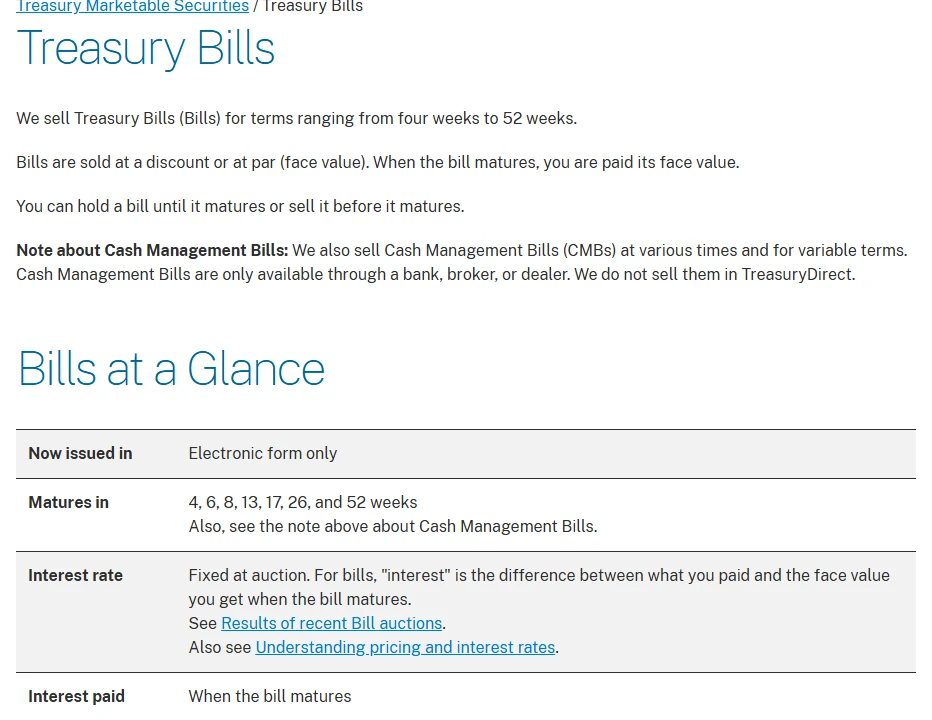
Where you can buy the short end yourself depends on where you live. In the US, TreasuryDirect sells bills with terms of 4, 6, 8, 13, 17, 26 and 52 weeks, from $100 in $100 steps, and says in so many words that you can hold a bill until it matures or sell it before. In the UK the equivalent bills are a wholesale product: the Debt Management Office's FAQ puts the minimum at its weekly tenders at £500,000, and says a member of the public would need a client relationship, directly or through a stockbroker, with one of the banks that bid. That is why UK savers who want the short end usually buy short-dated gilts through a broker or platform, or use the DMO's Gilt Purchase and Sale Service, which Computershare runs.
The limits: rate risk, reinvestment risk, and not beating inflation
Short-term bonds get called "steady" over and over, but "steady" is in no way the same as "no risk". There are three limits:
- Rate risk. They have low volatility, but not zero. When rates rise, the price of the bonds or bond funds you hold still falls; it is just that, because the term is short, the fall is usually limited. If you have to sell before maturity, you may not get back everything you expected.
- Reinvestment risk. Short term means they mature soon, and once they do you have to put the money back to work. If rates have dropped by then, the next round of income will be lower than before. Counting on them to lock in some high rate for the long run is not possible.
- Not beating high inflation. When inflation is clearly above their yield, the little interest they pay simply cannot cover the rise in prices, and your real purchasing power shrinks all the same. What they can steady is "nominal principal and liquidity", not "holding purchasing power inside high inflation". Government bonds whose principal is adjusted for inflation are covered separately in inflation-linked bonds.
Before you use them, keep these two in mind
- Don't mistake "steady" for "absolutely safe". They rarely default and have low volatility, but rate risk, reinvestment risk and not beating inflation are all real. Treating them as a safety cushion that can't go wrong will make you underestimate the risk.
- Don't reach for longer-duration or riskier debt just to earn a bit more. The moment you find the yield too low and stretch for long-term bonds or high-yield debt, you push this money from "steady" toward volatility and default risk, and that is exactly where many people come unstuck.
Short-term bonds are good at one very plain thing: letting money you don't need for now sit steadily, be available at any time, and earn a little interest along the way. Put in that role, they do the job well; expect more from them and you are using the wrong tool. To see what gold, the dollar and bitcoin each protect against and how volatile each is, see the safe-haven assets comparison.
FAQ
- Once I put money into short-term bonds, can I really not lose?
- No. They are low-volatility and rarely default, but they are not free of risk. When rates rise, their price falls; when you roll over at maturity the income can be lower; and most importantly, they can still fail to beat prices in high inflation. Their job is "steady plus liquidity", not "earning".
- How do ordinary people take part in short-term bonds, do I have to buy them directly?
- Not necessarily. There are three common routes: buying government bonds directly through an official channel, buying a money-market fund, and buying a short-bond ETF. Which is easier, what it costs, and how tax is handled vary by region and account, so follow your local official rules currently in force.
- Do short-term bonds protect against inflation?
- Only partly. Their interest moves with the rate environment, but when inflation is clearly above their yield, your real purchasing power can still shrink once prices rise. They are better at steadying principal and providing liquidity than at beating high inflation.
- Do you have to hold Treasury bills until they mature?
- No. TreasuryDirect states that you can hold a bill until it matures or sell it before. Sell early and you get that day's market price, which can be above or below what you paid; the shorter the time left, the smaller that gap tends to be. Hold to the end and you are paid the face value.
Sources
- TreasuryDirect: the US channel for individuals to buy government bonds, with descriptions of the available types (for other regions, follow your local official site).
- International Monetary Fund (IMF): public macro data on inflation and rates by economy, handy for comparing yields against inflation.