English
Where to keep an emergency fund so it is there on the bad dayChecking, an insured savings account and Treasury bills, split by how soon you would need each dollar
The FDIC's national rate table for August 2026 puts the average savings account at 0.38% a year and the average interest-bearing checking account at 0.07%. Over the twelve months to August, US consumer prices rose 3.4%. Leave an $18,000 emergency fund in an average savings account and it earns about $68 in a year, while rising prices take about $612 of what it can buy.
That gap is the usual reason people start moving an emergency fund around, and moving it is where it usually goes wrong: the money lands somewhere that pays more but cannot be reached on a Saturday, or would have to be sold at a loss. The split below keeps the fund reachable first and trims the inflation cost second. It assumes the size is already settled; if it is not, the emergency fund calculator works it out from your essential monthly spending.
On this page
Two questions to ask of any account
Could this money be in my checking account today, or within two business days, without anyone's approval? And would the amount that arrives be the amount I expected, give or take a little interest?
Emergencies come as a car repair on a Friday, a month without pay, a flight home at short notice. None of them waits for a price to recover or a notice period to run out. An account that fails either question can still be a fine home for other money; it is the wrong home for this money.
Yield is a third question, and it carries less weight than it seems to. On $18,000 the gap between a poor account and a good one is a few hundred dollars a year. The gap between money you can reach and money you cannot shows up on one bad day, and it can be the whole balance.
Split the money by when you would need it
Few emergencies need the whole fund on the first day. A job loss drains it month by month; a new boiler is one large bill. So the fund can sit in three places, each a little slower and a little better paid than the one before it.
| Layer | Where it sits | Time to reach checking | Protection |
|---|---|---|---|
| First 2 to 4 weeks | Your main checking account | Already there | FDIC insurance |
| Next 2 to 3 months | High-yield savings or a money market deposit account at an insured bank | Usually 1 to 3 business days by ACH | FDIC insurance |
| The remaining months | T-bills or a government money market fund at a broker | A sale settles the next business day, then a bank transfer | US government for bills; the fund is not insured |
The timings are typical, not promises. Cut-off times differ between banks and brokers, which is why the setup steps below include timing your own transfer once.
The first layer is sized to cover the wait while the other two are on their way. Transfers between two accounts at the same bank are usually faster. If money from a separate savings bank takes two business days to land, an emergency on Friday evening means waiting until Tuesday, and checking has to carry you until then.
A household with irregular income, or with a single earner, usually makes the first two layers bigger and the third smaller. Someone on a steady salary with a partner who also earns can lean harder on the third. Neither is wrong. It comes down to how fast the fund would be drawn down.
What each layer pays, on real numbers
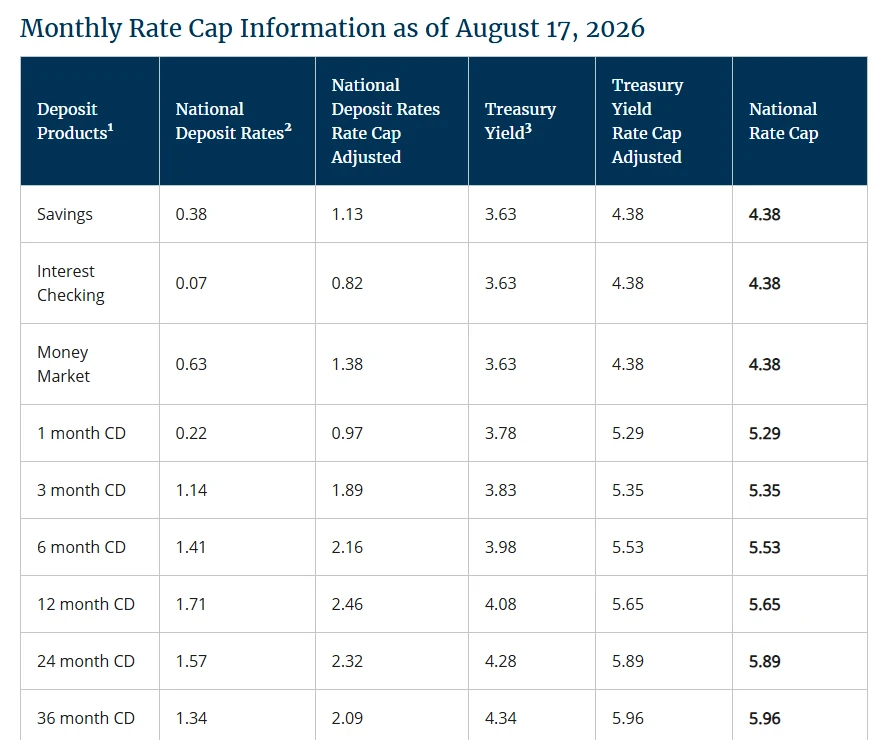
Those averages are pulled down by large banks paying close to nothing on balances they expect to stay put. Online banks and credit unions often pay many times the average, and they can change the rate whenever they like, so go by the APY on the account page the day you open it rather than a comparison list from last month.
Treasury bills follow short-term interest rates closely. The Treasury's daily table for 18 September 2026 shows coupon-equivalent yields of 3.89% on 4-week bills, 4.08% on 13-week bills and 4.27% on 26-week bills. Bill interest is taxed federally but not by states or localities, which counts for something if your state income tax is high.
| Where the money sits | Interest in a year | Buying power lost to prices | Net |
|---|---|---|---|
| All $18,000 in an average savings account at 0.38% | about $68 | about $612 | about −$544 |
| $3,000 in checking at 0.07%, $6,000 in average savings at 0.38%, $9,000 in 13-week bills at 4.08% | about $392 | about $612 | about −$220 |
Second row: $2 + $23 + $367. Bill yields reset each time the bills roll over, so read this as a sense of scale. A savings account paying close to bill rates narrows the gap further.
Neither row keeps up with prices, and an emergency fund is not built to. Its job is to stop you selling investments or borrowing on a card at the worst moment. On these numbers the split cuts the cost of holding it by about $324 a year without giving up access. To see what your own fund earns after inflation, enter its rate in the real return calculator.
Who pays you back if the firm fails
A deposit at an FDIC-insured bank is covered up to at least $250,000 per depositor, per insured bank, per ownership category. For nearly everyone that covers the whole emergency fund. What needs checking is whether you are a depositor at a bank at all.
Many savings apps are not banks. They place your money with a partner bank, and the FDIC's guidance on third-party apps says it plainly: nonbank companies themselves are never FDIC-insured. If the partner bank fails, pass-through coverage may apply, provided the records show whose money is whose. If the app company fails, deposit insurance does not apply, and getting the money back can mean waiting on a bankruptcy process. Before moving an emergency fund into an app, find the name of the bank that will hold it and look that bank up on the FDIC's BankFind tool.
Money market funds are a different product with a similar name. The SEC's investor bulletin draws the line: a money market deposit account at a bank is FDIC-insured up to the limits, while a money market fund, like any mutual fund, is not, and you can lose money in one. Government money market funds put 99.5% or more of their assets in cash, government securities and repurchase agreements backed by them, which is why they are the kind usually suggested for cash. SIPC protection at a brokerage covers cash and securities missing when a member firm fails, up to $500,000 including $250,000 in cash. It does not cover a fall in value.
Outside the US the reasoning is the same and the limits differ. In the UK the FSCS has covered deposits up to £120,000 per person per authorised firm since 1 December 2025, and some banks share one licence, so two brands can count as a single firm. In Canada, CDIC covers eligible deposits, GICs included, up to $100,000 in each category, with deposits in a TFSA as a category of their own; mutual funds, ETFs and cryptocurrencies are not covered.
The TreasuryDirect catch
Buying bills straight from the Treasury at TreasuryDirect costs nothing and cuts out the middleman. It also makes the money slower to reach than most people expect.
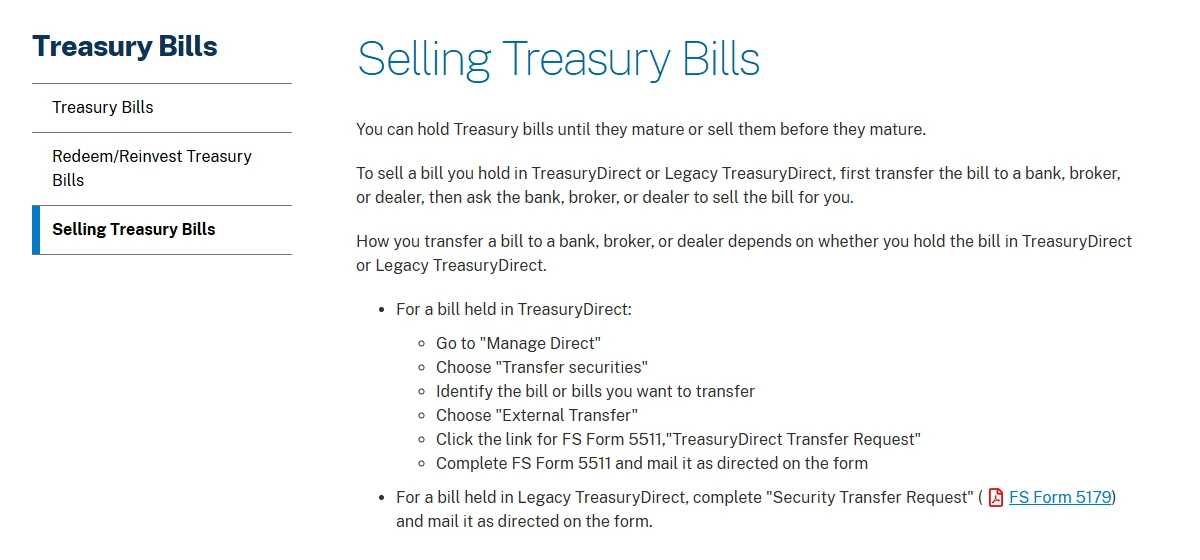
A bill cannot be sold inside TreasuryDirect. To sell before maturity you transfer it to a bank, broker or dealer and ask them to sell it. TreasuryDirect also holds new purchases: a security bought there must stay in the account for 45 days before it can be sold or transferred, so a 4-week bill, which matures in 28 days, cannot be sold early at all.
That leaves two workable setups. One is to buy the bills in an ordinary brokerage account, where they can be sold on any trading day. The other is to keep them at TreasuryDirect as a ladder: split the third layer into three or four parts and buy 13-week bills a few weeks apart, so one matures every few weeks and pays into your bank account on its maturity date. A ladder only works if the first two layers can cover the wait until the next bill comes due.
Places that fail the test
Certificates of deposit pay more than the average savings account, 1.71% on average for a 12-month CD in the FDIC table, but each bank sets its own early-withdrawal penalty, commonly a few months of interest. A no-penalty CD avoids that; read the terms for how soon after opening a withdrawal is allowed.
I bonds keep pace with inflation and pay 4.26% on bonds issued from 1 May to 31 October 2026, which makes them tempting. They cannot be cashed at all for the first 12 months, and cashing in before five years costs the last three months of interest. They can hold money you will not touch for a year; they cannot be the fund. The inflation-linked bonds guide explains how their rate is built.
Stock and bond funds fail the second question. The month you lose a job can be a month the fund is down 15%, and redundancies tend to cluster when markets are weak. Gold fails it for the same reason, with a dealer spread on the way out as well; the gold guide puts numbers on that spread.
Bitcoin and other crypto-assets fail both questions. Prices can move by double digits in a week, and withdrawals run through an exchange that can pause them. Stablecoins hold close to a dollar most of the time, but they are not bank deposits, and CDIC lists stablecoins among the products it does not cover. Crypto may have a place in money you invest; it has none in money you might need next week.
A little cash at home is worth having, enough to get through a few days if card networks or the power go down. Beyond that it earns nothing and is not insured against theft or fire.
Setting it up in one afternoon
- Write down the target and the three layer sizes. With essential spending of $3,000 a month and six months of cover, that is $18,000: for example $3,000 in checking, $6,000 in savings and $9,000 in bills or a government money market fund.
- Open the savings account at an insured bank. Search the bank's legal name on BankFind; if you are signing up through an app, find the partner bank's name in the account terms first.
- Link it to checking and move $10 across on a weekday afternoon. Note when it leaves and when it lands. That is your real transfer time, and it tells you how large the first layer has to be.
- For the third layer, use a brokerage account you already have or open one. Buy a government money market fund or 13- and 26-week bills, and switch on automatic rollover for the bills if the broker offers it.
- Rename the accounts so they cannot be mistaken for spending money, and do not order a debit card for the savings account.
- Decide the refill order now: after using the fund, top up checking first, then savings, then the third layer.
- Put a date in the calendar once a year to check whether essential spending has gone up, and resize the layers to match.
Building the fund from nothing works in the same order. The first month of spending goes into checking, the next two into savings, and bills can wait until those are full.
FAQ
- Should an emergency fund be in a high-yield savings account?
- Most of it can be. A high-yield savings account at an FDIC-insured bank passes both tests: the money reaches your checking account in a day or two and the balance does not fall. Keep a few weeks of spending in checking to cover transfer delays, and check that the provider is a bank, or names the bank that holds your money.
- Is a money market fund safe for an emergency fund?
- A government money market fund invests almost entirely in cash and government securities, so large losses are unlikely, but it is not FDIC-insured and it is possible to lose money in one. It suits the slower part of the fund, the months you would need after the first few, rather than the first few weeks.
- Can I keep my emergency fund in Treasury bills?
- Part of it. Bills are backed by the US government and their interest is free of state and local income tax. Buy them in a brokerage account if you might need to sell early: at TreasuryDirect a new purchase cannot be sold or transferred for 45 days, and a 4-week bill cannot be sold before it matures.
- How much of an emergency fund should be kept as cash at home?
- Only enough for a few days if cards or cash machines stop working, for example during a power cut. Cash at home earns nothing and is not insured against theft or fire.
Sources
- FDIC: National Rates and Rate Caps: average deposit rates by product, August 2026 update.
- FDIC: Banking With Third-Party Apps: coverage limits, pass-through insurance and what happens if a nonbank company fails.
- BLS: Consumer Price Index summary: the August 2026 release.
- US Treasury: Daily Treasury Bill Rates: coupon-equivalent yields for 18 September 2026.
- TreasuryDirect: Treasury Bills: terms, minimum purchase and tax treatment.
- TreasuryDirect: Selling a Treasury Marketable Security: the 45-day hold and the 4-week bill exception.
- TreasuryDirect: I bonds: current rate, 12-month minimum and early-redemption rule.
- SEC Investor.gov: Money Market Funds bulletin: fund types and the difference from bank deposit accounts.
- SIPC: What SIPC Protects: limits and what is not covered.
- FSCS: Deposit protection limit and CDIC: What's covered: UK and Canadian deposit protection.