English
Binance sign-up: where the invite code goes, what KYC needsWalk it in order, and know which step you cannot skip
Everything else on this site is about understanding first. This is the one page about actually doing it. The process itself is not hard; the difficulty is knowing which step you cannot skip. People reach the end and find there is nowhere left to enter an invite code, or get an identity check bounced three times without being told what was wrong. This runs through it in order and flags the places that genuinely trip people up.
One thing worth saying that you rarely hear: opening the account is not the point. If you have not yet settled how much you are putting in or what for, go back to how much to allocate and come back afterwards. The account will still be there. This page solves one problem only: once you have decided to open one, how to do it without wasting the trip.
If the decision is already made, there is no need to finish this page first: go straight to sign-up with code BNW88. It takes a few minutes, and signing up this way carries a trading-fee discount, up to whatever the sign-up page shows at the time. If you would rather see every step before touching anything, keep reading.This is a promotional link. Crypto trading carries risk, and none of this is investment advice.
On this page
- Three things to confirm first
- The steps, and where the invite code actually goes
- What KYC needs, and why it gets rejected
- Verification tiers and limits: why a passed check can still block a withdrawal
- Three settings to do the moment the account exists
- Where the fees actually sit, and which one the discount touches
- Week one: run the whole route with an amount you would not miss
- If you get stuck
- When to stop instead
- FAQ
Three things to confirm first
None of these takes five minutes, but miss one and you will be starting over later.
- Whether it is available where you are. Rules on crypto platforms differ sharply between countries, some regions have limited functionality and others no access at all, and that list changes. Check the official page for your own location before you start, rather than going on what somebody reported a year ago.
- An identity document that has not expired. Passport or national ID both work. What matters is that it is in date and that the name on it matches the name you are about to type. If it is close to expiry, renew it first; that is easier than getting stuck halfway through a review.
- An email address and phone number only you can reach. Not a shared mailbox, not somebody else's number. These two are how you recover the account and receive verification later. An account that depends on someone else's access is not really yours.
The steps, and where the invite code actually goes
The form itself takes a few minutes. The order runs like this:
- Open the sign-up page. The link above takes you straight there. What you should never do is arrive from a link in an unexpected message, email or group chat, which is the most common way people land on a fake page.
- Enter an email or phone number and set a password. Give it its own password, not the one already guarding your email or social accounts.
- Expand the invite code field and enter the code. This is the step people miss: the field is usually collapsed on the sign-up page, labelled something like referral code or referral ID, and you will not see it unless you open it. The code for this site is BNW88.
- Enter the verification code and finish. These expire quickly. If nothing arrives, check the spam folder before hitting resend repeatedly.
Step three is worth repeating on its own: the code binds at the moment the account is created, and once the account exists it generally cannot be added. There is nothing hidden about this rule. It is simply that most people click through the flow without ever noticing the collapsed field. If you intend to use a code at all, slow down for one screen before you submit.
As for how much it takes off, go by what the exchange sign-up page shows at the time. Promotion rules change, so this site does not print a fixed figure.
What KYC needs, and why it gets rejected
KYC just means identity verification. Every major platform treats it as the condition for full access, and it comes from anti-money-laundering rules in each jurisdiction rather than a hurdle the platform invented. Since you cannot avoid it, it is worth getting right the first time.
Have these ready before you start: the physical document (not a photocopy, and not a photo of a screen), somewhere with even light, and a few minutes without interruption. When you photograph the document, keep all four corners inside the frame, do not cover any of the details with a finger, and watch that the flash does not blow out a patch of it. For the face check, take off hats and glasses and follow the prompts.
Rejections come down to the same handful of causes:
- The document has expired. The most common one, and plenty of people genuinely do not realise theirs has run out.
- The name does not match. What you typed differs from the document, even if only by a middle name, a transliteration order or a single space.
- The image is not readable. Blurred, glared, a corner cut off, or photographed from a screen.
- Proof of address does not meet the requirement. Where this is asked for, it usually has to be a recent bill or bank statement with a name and address that line up with the account.
Reviews can clear in minutes or take several working days at busy periods. Exchanges make no promise about that window, so go by the official page at the time. While you wait, do not resubmit. It does not jump the queue and may push you back down it.
Verification tiers and limits: why a passed check can still block a withdrawal
Verification usually comes in tiers, and clearing one of them unlocks only that tier. Each carries its own set of functions and its own ceilings, which is why a message saying the check passed can sit quite happily alongside a blocked withdrawal or a rejected deposit.
The shape of it runs roughly like this. The lowest tier tends to cover browsing and small amounts. Submitting an identity document opens up considerably more. Anything above that usually asks for something like proof of address. What the tiers are called, what each one permits and which documents they want all differ by country and get revised as rules change, so read the verification page inside your own account rather than copying figures from somebody else's screenshot.
Two details get missed. Ceilings are often counted over a rolling period, daily or monthly, so exhausting one means waiting for the window to turn over rather than paying to lift it. And separate functions usually carry separate ceilings: what you may move in as cash and what you may take out as coin are not drawn from the same pool. Before committing a large sum, confirm on a small one what your particular tier actually permits, rather than discovering the wall at the moment you need to be through it.
Three settings to do the moment the account exists
Plenty of people go straight to funding and leave these until later. Together they take under ten minutes, and they are the line between an account that is yours and one that is only yours until someone else gets interested.
- Turn on two-factor authentication, using an authenticator app rather than SMS. Text messages look convenient, but a phone number can be taken over through a SIM swap. Codes generated in an app live on your own device. Write down the backup key and keep it somewhere safe; you will need it when you change phones.
- Set a withdrawal whitelist. With it on, funds can only leave to addresses you added in advance. Even if someone does get into the account, they cannot simply move the money out.
- Set an anti-phishing code. Once set, genuine emails from the platform carry a short code only you know. Anything arriving without it can be treated as fake without further thought.
One rule outranks all three: an exchange will never ask you for your password, your two-factor code or a wallet seed phrase. It does not matter whether the person claims to be support, a security team or a partner of some kind. Anyone asking for any of those three is running a scam, with no exceptions. The same goes for this site: we never ask for account details and never operate an account on anyone's behalf.
Where the fees actually sit, and which one the discount touches
You are partly here because of a discount, so it is worth being precise about what it applies to. An exchange can charge you in more than one place, and those places are independent of one another.
| Charged where | Charged when | Roughly how | Discount applies |
|---|---|---|---|
| Trading fee | Every time an order fills | A small share of the amount traded; maker and taker usually differ | Yes |
| Withdrawal fee | When coins leave the exchange | Set by the coin and the network used, unrelated to how much you traded | No |
| Moving cash in and out | Card or third-party rails | Usually set by the rail, and varies a great deal between countries | No |
The table names the moment each charge happens, not the size of it. Rates get revised, so read the fee page on the day rather than trusting a figure quoted anywhere else.
The discount applies to the first row: the slice taken each time an order fills. The more often you trade, the larger that line looms in your total cost and the more a discount is worth to you. If the plan is to buy once and leave it alone for years, the effect on what you actually spend is modest. That is a duller thing to say, and more honest than letting you picture a large saving.
Week one: run the whole route with an amount you would not miss
The commonest mistake on the day an account opens is moving the entire intended sum across at once. Do the opposite. Send an amount small enough that losing it would not move you, and take it all the way round: in, buy, sell, out. None of this trip is meant to earn anything. It exists to prove that every link in the chain works for you specifically.
In practice: deposit a small sum and confirm it lands; buy a little of something mainstream and read both the fill price and what was actually deducted; sell part of it back; then withdraw a small amount to an account or wallet you control and watch it arrive. That final step is the one people skip and the one that matters most. An account money can enter but not leave is not an account that holds your money.
Keep one line of notes as you go: date, amount, how long each leg took, what came off. Three months later that record will serve you better than any guide, because it describes your route rather than someone else's. Only once the round trip works does the sum you actually planned become a sensible next step, and only then has everything above turned into something real.
If you get stuck
- The verification code never arrives. Check spam and promotions first, then confirm the address has no typo. Hammering resend can trip a rate limit and make it slower, so wait a few minutes or switch verification method.
- The review sits in the queue. Busy periods are simply slow. If what you submitted was sound, waiting is the whole strategy.
- You finished and realise the code went in nowhere. There is no good fix here; it generally cannot be added later. Next time, open that collapsed field first.
- It says your region is not supported. Go by the official page, and do not go looking for someone offering to register on your behalf. That hands your account to a stranger, and if it goes wrong afterwards you have almost no standing to claim it back.
Bitcoin Wiki keeps a category page listing exchanges, and the first thing on it is not a list. It is a red box saying that exchanging or storing significant funds with exchanges is not recommended, because sending funds to one means trusting that the operator will not abscond with them and that it keeps systems secure against theft from inside and out. The suggestion that follows is a practical one: find out who actually runs the place, and check what recourse you would have if it went wrong.
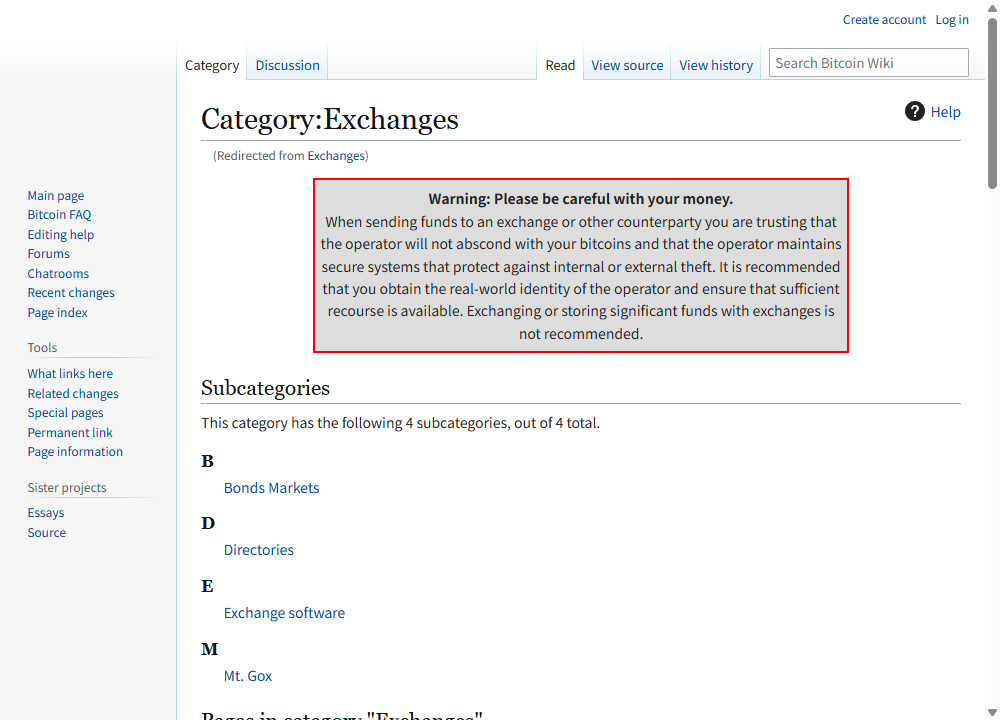
None of that is an argument against opening the account. It is an argument about what the account is for. Buying, selling and moving money in and out happen here. How much of your money lives here between those moments is a different question, and worth deciding on its own terms rather than by default.
When to stop instead
- Someone offers to sign up or verify on your behalf. However helpful they sound, an account opened on another person's documents is not under your control.
- Anyone asks for a password, a verification code or a seed phrase. That is a scam every time. End the conversation.
- Funding it would mean borrowing or touching your emergency money. This is the line HoldValue holds throughout: only money you could lose entirely. If that is not the case here, do not open the account yet.
FAQ
- I finished signing up and forgot the invite code. Can I add it now?
- Generally no. The code binds at the moment the account is created, and once the account exists it usually cannot be added afterwards. So if you intend to use one, it has to go in before you submit. The exact rule is whatever the exchange page states at the time.
- Is identity verification compulsory, and what happens without it?
- Major exchanges treat identity verification as the condition for full access. It comes from anti-money-laundering rules in each jurisdiction rather than the platform being awkward. Unverified accounts are normally limited in both allowances and available features, with the specific limits as shown on the official page at the time.
- How long does the whole thing take?
- Filling in the forms takes a few minutes. The part that actually costs time is the identity review, which can clear in minutes or take several working days at busy periods. Exchanges make no promise about that window, so go by what the official page says at the time. Resubmitting does not speed it up and may put you back in the queue.
- Does using an invite code make me pay more?
- It does not cost you more. What a code can do is give you some level of trading fee discount, with the rate, the promotion rules and regional availability all as shown on the exchange sign-up page at the time. You should also know that this site may earn a commission if you register using the code.
- Is the withdrawal fee the same thing as the trading fee?
- They are two separate charges. The trading fee comes off each time an order fills, as a share of the amount traded. The withdrawal fee is charged when coins leave the exchange, set by the coin and the network, with no relation to how much you traded. A code's discount normally touches the first of these, and what you actually pay is whatever the page shows at the time.
- Should I fund the account straight after opening it?
- There is no hurry. A steadier order is to set up two-factor authentication, the withdrawal whitelist and the anti-phishing code first, then send an amount you would not miss all the way round: in, buy, sell, out. Once each leg has worked for you, the sum you actually planned becomes a reasonable next step.