English
Your bond's principal rises with prices. So why can it still lose money?How TIPS and index-linked gilts work, when they beat ordinary bonds, and which money suits them
On 10 September 2026 the Federal Reserve's H.15 table listed two ten-year US Treasury yields a few rows apart: 4.95% for the ordinary kind and 2.55% for the inflation-indexed kind. Read quickly, the second looks like the worse deal. It is really a different promise, and nearly everything worth knowing about inflation-linked bonds follows from that gap.
In the US they are Treasury Inflation-Protected Securities, or TIPS; in the UK, index-linked gilts, usually just called linkers. Both lift the principal when prices rise and pay interest on the lifted amount. Neither promises a steady price on the way to maturity, which is the part people tend to learn from a statement rather than a brochure.
On this page
Two yields that measure different things
An ordinary Treasury quotes a nominal yield. Whatever the market expects inflation to be over the life of the bond is already baked into that number. A TIPS quotes a real yield: the return you get on top of inflation, with the inflation part delivered separately, through adjustments to the principal.
So the 4.95% and the 2.55% are not two prices for the same thing. The first is everything you will be paid; the second is only what you will be paid beyond keeping up with prices. On the same day the five-year pair was 4.75% and 2.29%.
If the real-versus-nominal idea is new, the piece on bank savings and real interest rates walks through it with a deposit instead of a bond.
What $1,000 of TIPS looks like after a year of 3% inflation
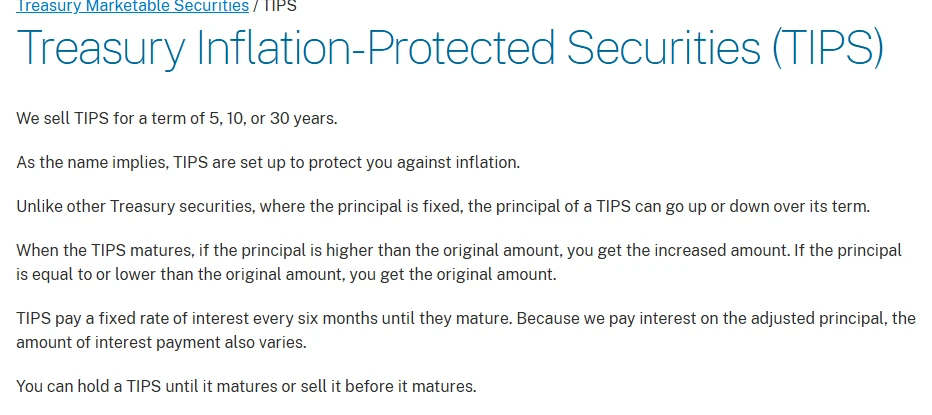
TreasuryDirect, the US Treasury's own site, sets out the mechanics plainly. TIPS come in 5, 10 and 30-year terms, with a $100 minimum in $100 steps, and pay interest every six months. The interest rate is fixed at auction and never changes. What moves is the principal, which is adjusted up or down with the consumer price index, and because each interest payment is the fixed rate applied to the adjusted principal, the dollar amount of interest moves with it.
Round numbers make the direction easy to see. Buy $1,000 of TIPS with a fixed rate of 1.5%. Over the year CPI rises 3%, so the principal becomes $1,030. The year's interest is worked out on $1,030, about $15.45 rather than $15. The small difference compounds: if inflation keeps running at a few percent, the principal keeps stepping up, and at maturity you are repaid that stepped-up figure, not the $1,000 you started with. The Treasury's real calculation uses a daily index ratio; the rounding here is only to show the direction.
In a year of falling prices the principal is adjusted down. There is a floor, but only at the end: if the adjusted principal at maturity is at or below the original amount, you get the original amount. Sell before maturity and the price you get carries no such floor.
Will it beat an ordinary Treasury?
Subtract one ten-year yield from the other: 4.95% − 2.55% = 2.40 percentage points. That gap is the breakeven inflation rate, the market's price for average US inflation over the next decade. If inflation averages more than that, the TIPS holder comes out ahead; less, and the ordinary Treasury wins; about the same, and there is little in it.
| Average inflation over ten years | TIPS as a nominal annual return | Ordinary Treasury | Who ends up ahead |
|---|---|---|---|
| 2.0% | about 4.60% | 4.95% | Ordinary Treasury |
| 2.4% | about 5.01% | 4.95% | Roughly level |
| 3.0% | about 5.63% | 4.95% | TIPS |
| 4.0% | about 6.65% | 4.95% | TIPS |
The TIPS column is (1 + 2.55%) × (1 + inflation) − 1. What matters is where the two lines cross, not the exact figures; yields change daily, so rerun it with the numbers on the day you look.
Put another way, buying TIPS means declining to bet on inflation. Whatever it turns out to be, your money keeps pace with it and earns the real yield on top. Buying them in the hope of beating ordinary Treasuries is a bet that inflation will exceed the 2.4% the market has already priced, which is a forecast, however it is dressed.
How a linker can fall while prices are rising
The inflation adjustment protects what you are repaid at maturity. Until then, the price is set by the real yield, and real yields move every trading day.
Linkers follow the same rule as any bond: when yields rise, the price of bonds already issued falls, and the longer the time left to run, the bigger the fall. Treating them as zero-coupon bonds for a rough sense of scale, a rise in the real yield from 2.0% to 3.0% takes about 4.8% off a bond with five years left, about 9.3% off one with ten, and about 25% off one with thirty.
That is how a holder of long-dated linkers can watch the price fall through a stretch of high inflation. When real yields climb from a low starting point, the price drop can outrun the principal adjustments. Anyone who holds to maturity still gets the inflation-adjusted principal back; anyone who has to sell along the way takes the loss for real.
For money you may need in the next few years, keep to short remaining terms, or use short-term Treasuries instead; a thirty-year linker is the wrong tool for next year's prices. The short-term bonds guide has a table of how much a one-point rate rise moves each maturity.
TIPS, I bonds and index-linked gilts
TIPS are marketable Treasuries. You can buy them at auction in a TreasuryDirect account, or buy and sell them through a broker. Everything above, the principal adjustment, the six-monthly interest and the floor at maturity, describes them. On tax, TreasuryDirect's summary notes that federal tax is due each year on the interest, and the same entry goes on to deal with increases and decreases in the principal during the year. If you file in the US, work out how that lands on your own return before holding them outside a tax-advantaged account.
I bonds work differently. They are savings bonds and do not trade in the market. The rate has two parts: a fixed rate that never changes and an inflation rate that resets every six months. TreasuryDirect currently shows 4.26% for I bonds issued from 1 May 2026 to 31 October 2026, including a fixed rate of 0.90%. Since 1 January 2025 they have been electronic only, bought in a TreasuryDirect account, and the same site sets out purchase limits and a minimum holding period.
Index-linked gilts are issued by the UK Debt Management Office. Both the principal and the six-monthly coupons are tied to the Retail Prices Index, with an indexation lag of a few months, so a payment made this month reflects prices from some months earlier. Individuals usually buy them through a broker or investment platform, or through the DMO's Gilt Purchase and Sale Service, which Computershare administers.
Money it suits, and money it doesn't
A useful test: will the thing this money is meant for get more expensive as prices rise?
School fees due in five years, or retirement spending ten years out, rise with prices by nature. Matching them with bonds whose principal rises with prices is the job these instruments do best, provided you can realistically hold to maturity.
Money you may need within a year is a poor fit, for the reason in the previous section. So is money you want to grow faster than prices: what you get is inflation plus the real yield, and nothing extra.
One group gets pointed at them often: savers in countries whose currency keeps weakening. TIPS track US CPI and linkers track UK RPI; they compensate for prices in the issuing country. How far your own currency falls against the dollar or the pound is a separate matter, covered only by the fact that the asset is priced in that currency. To see whether your savings are earning a positive real return at all, put the nominal rate and inflation into the real return calculator.
FAQ
- Can TIPS lose money?
- Held to maturity, you get back the inflation-adjusted principal (or the original amount if prices have fallen over the term), plus interest at the fixed rate along the way, so your purchasing power broadly keeps pace with US prices. Sold before maturity, they can lose: when real yields rise the price falls, and the longer the time left, the bigger the fall.
- What is the breakeven inflation rate?
- It is the gap between the nominal and the inflation-indexed yield for the same maturity. On 10 September 2026 the ten-year gap was about 2.40 percentage points. If inflation averages more than that over the term, TIPS end up ahead of ordinary Treasuries; if less, ordinary Treasuries do.
- Are index-linked gilts the same as TIPS?
- They work on the same idea but follow UK rules. Index-linked gilts are issued by the UK Debt Management Office and tied to the Retail Prices Index with an indexation lag of a few months, while TIPS are issued by the US Treasury and adjusted with the US consumer price index.
- Do inflation-linked bonds protect against my own currency falling?
- No. They compensate for inflation in the country that issues them. A fall in your currency against the dollar or the pound is a separate risk; holding an asset priced in that currency is what addresses it, and the exchange rules where you live decide how you get there.
Sources
- TreasuryDirect: TIPS: terms, minimum purchase, interest and repayment at maturity.
- TreasuryDirect: I bonds: how the rate is built and the current composite rate.
- Federal Reserve H.15 Selected Interest Rates: daily nominal and inflation-indexed Treasury yields; the figures here are for 10 September 2026.
- UK Debt Management Office FAQs: how index-linked gilts reference RPI, and the Gilt Purchase and Sale Service.